Description
API 7K Mud Jumper Hose for High-Pressure Mud Circulation, Manifolds & Drilling Rigs
SGPE manufactures and supplies API 7K Mud Jumper Hose assemblies for high-pressure drilling mud circulation on land rigs, offshore platforms, jack-up rigs, semi-submersibles and drillships.
A Mud Jumper Hose provides a flexible high-pressure connection between compatible fixed sections of the surface mud system. It is used where rigid piping cannot easily accommodate connection offsets, limited routing space, equipment alignment or controlled relative movement.
Typical installations include mud manifold crossovers, surface high-pressure mud lines, fixed standpipe manifold crossovers, auxiliary drilling fluid lines, circulation packages and rig retrofit connections.
Depending on the project, the same product may appear in procurement documents as a Drilling Mud Jumper Hose, API 7K Jumper Hose, High Pressure Mud Hose, Mud Manifold Hose, Mud Delivery Hose, Mud Circulation Hose, Flexible Mud Hose, Oilfield Mud Hose or Drilling Rig Mud Hose.
SGPE supports drilling contractors, rig builders, oilfield service companies, petroleum equipment suppliers and EPC contractors with application-based hose selection. The most common commercial requirements are Grade D 5000 PSI Mud Jumper Hose and Grade E 7500 PSI Mud Jumper Hose, with FSL 1 or FSL 2 selected according to the operating condition.
Hose ID, overall length, temperature range, Side A and Side B connections, protective accessories, inspection and documentation can be configured around the actual drilling system.
For a faster API 7K Mud Jumper Hose quotation, provide the hose ID, working pressure, FSL, overall length, drilling fluid, operating temperature, installation position and both end connections.
API 7K Mud Jumper Hose Technical Specifications
Pressure, Size and Service Parameters
The following data provides a practical reference for preliminary hose selection. Final pressure grade, hose ID, FSL and temperature range should be confirmed against the approved project data sheet.
| Technical Item | SGPE Reference / Project Requirement |
|---|---|
| Product | API 7K Mud Jumper Hose |
| Product Type | High-Pressure Drilling Mud Hose Assembly |
| Applicable Standard | API Spec 7K; project-required edition to be confirmed |
| Main Service | High-pressure drilling mud and compatible drilling fluid circulation |
| Main Commercial Grades | Grade D 5000 PSI / Grade E 7500 PSI |
| Other Grade | Grade C where applicable |
| Rated Working Pressure | Up to 7,500 PSI for Grade E configurations |
| Test Pressure | 1.5 × rated working pressure |
| Minimum Burst Pressure | 2.5 × rated working pressure |
| FSL | FSL 1 or FSL 2 |
| Temperature Range | Range I, II or III according to qualified hose design |
| Hose ID | API-defined combinations from 2 in. to 6 in., depending on grade |
| Overall Length | Customized to project requirements |
| Minimum Bend Radius | Defined by hose ID and pressure grade |
| Main Fluids | Water-based, compatible oil-based and synthetic-based drilling mud |
| Sour / H2S Service | Requires project-specific service and material review |
Construction, Connections and Project Requirements
Hose construction, end connections, inspection and documentation should match the actual rig layout and operating conditions.
| Technical Item | SGPE Reference / Project Requirement |
| Inner Tube | Drilling-fluid-compatible elastomeric construction |
| Reinforcement | High-strength reinforcement according to hose pressure design |
| Outer Cover | Oil, abrasion, ozone and weather-resistant protective construction |
| End Connections | Hammer union, flange, hub, integral connector, butt-welded connector or custom end |
| Common Oilfield Ends | Fig. 1002 / Fig. 1502 style configurations where suitable |
| Side A / Side B | Same or different compatible end configurations |
| Above 5000 PSI | API 5B line-pipe-thread attachment between hose coupling and end connector is not used |
| Typical Installation | Flexible crossover between compatible fixed sections of the surface mud system |
| Rig Environment | Land rig, jack-up, offshore platform, semi-submersible and drillship |
| Pressure Testing | Hydrostatic testing according to applicable requirements |
| Inspection | Project-specific inspection and TPI support where agreed |
| Documentation | Technical data, hydrotest record, inspection records, COC and agreed project documents |
API 7K Mud Jumper Hose Pressure Grades
Working pressure is one of the first items to confirm, but it should not be considered alone. Mud flow, pulsation, FSL, temperature, hose ID, bend radius and connection ratings all influence final selection.
| API Grade | Rated Working Pressure | Test Pressure | Minimum Burst Pressure | Typical Application |
| Grade C | 27.6 MPa / 4,000 PSI | 41.4 MPa / 6,000 PSI | 69.0 MPa / 10,000 PSI | Moderate-pressure drilling mud circulation |
| Grade D | 34.5 MPa / 5,000 PSI | 51.7 MPa / 7,500 PSI | 86.3 MPa / 12,500 PSI | High-pressure mud manifolds and surface mud lines |
| Grade E | 51.7 MPa / 7,500 PSI | 77.6 MPa / 11,250 PSI | 129.3 MPa / 18,750 PSI | Higher-pressure drilling mud circulation |
SGPE mainly handles enquiries for Grade D 5000 PSI and Grade E 7500 PSI Mud Jumper Hose assemblies.
The pressure rating of the complete hose assembly cannot exceed the rating of its lowest-rated pressure-containing component. Unions, flanges, hubs, adapters and mating equipment therefore need to match the selected hose pressure class.
Grade D 5000 PSI Mud Jumper Hose
A Grade D 5000 PSI Mud Jumper Hose suits many high-pressure drilling mud circulation systems.
The Grade D combinations covered on this page range from 2 in. through 6 in. hose ID. Rated working pressure is 5,000 PSI / 34.5 MPa, test pressure is 7,500 PSI / 51.7 MPa, and minimum burst pressure reaches 12,500 PSI / 86.3 MPa.
Grade D is commonly specified for mud manifold jumper hose assemblies, surface high-pressure mud lines, drilling fluid distribution connections and rig retrofit projects.
Typical RFQs may describe the requirement as a 5000 PSI Mud Jumper Hose, API 7K Grade D Hose, 5000 PSI Drilling Mud Hose, High Pressure Mud Line Hose or replacement mud hose assembly.
Grade E 7500 PSI Mud Jumper Hose
A Grade E 7500 PSI Mud Jumper Hose supports higher-pressure drilling mud circulation.
The Grade E combinations covered here start at 2-1/2 in. and extend through 6 in. Rated working pressure reaches 7,500 PSI / 51.7 MPa, test pressure reaches 11,250 PSI / 77.6 MPa, and minimum burst pressure reaches 18,750 PSI / 129.3 MPa.
Common procurement descriptions include 7500 PSI Mud Jumper Hose, API 7K Grade E Hose, 7500 PSI Drilling Hose, Grade E Mud Hose, FSL 2 Grade E Hose and Offshore High Pressure Mud Hose.
Because Grade E operates above 5,000 PSI, the interface between the hose coupling and end connector requires a suitable higher-pressure arrangement. Qualified configurations use an integral or butt-welded end connector rather than an API 5B line-pipe-thread attachment at that interface.
API 7K Mud Jumper Hose Sizes and Minimum Bend Radius
Minimum Bend Radius, or MBR, directly affects hose routing, available installation space and loading near the end connections.
| Hose ID | Grade C 4000 PSI MBR | Grade D 5000 PSI MBR | Grade E 7500 PSI MBR |
| 2 in. / 50.8 mm | 0.9 m / 36 in. | 0.9 m / 36 in. | — |
| 2-1/2 in. / 63.5 mm | 0.9 m / 36 in. | 0.9 m / 36 in. | 1.2 m / 48 in. |
| 3 in. / 76.2 mm | 1.2 m / 48 in. | 1.2 m / 48 in. | 1.2 m / 48 in. |
| 3-1/2 in. / 88.9 mm | 1.4 m / 54 in. | 1.4 m / 54 in. | 1.4 m / 54 in. |
| 4 in. / 101.6 mm | 1.4 m / 54 in. | 1.4 m / 54 in. | 1.5 m / 60 in. |
| 5 in. / 127.0 mm | 1.5 m / 60 in. | 1.5 m / 60 in. | 1.8 m / 72 in. |
| 6 in. / 152.4 mm | — | 1.8 m / 72 in. | 1.8 m / 72 in. |
MBR refers to the hose centerline.
Hose ID and pressure grade should be selected together. A larger end connection does not automatically mean that the flexible hose itself requires the same bore.
For preliminary sizing, provide the drilling mud flow rate, existing line bore, system pressure and available routing radius.
Temperature Range and FSL Selection
Temperature and pressure pulsation both influence hose selection.
| Item | Reference Condition | Typical Selection Use |
| Temperature Range I | -20°C to +82°C / -4°F to +180°F | Common drilling mud temperature service |
| Temperature Range II | -20°C to +100°C / -4°F to +212°F | Higher-temperature drilling fluid service |
| Temperature Range III | -20°C to +121°C / -4°F to +250°F | High-temperature qualified hose design |
| FSL 1 | Jumper hose for normal service | Conventional drilling circulation |
| FSL 2 | High-frequency pulsation above 6.9 MPa / 1,000 PSI amplitude | Severe pulsation service |
The selected hose design must qualify for the required temperature range.
An API 7K FSL 1 Mud Jumper Hose suits normal drilling service. An API 7K FSL 2 Mud Jumper Hose addresses systems that can experience high-frequency pressure pulsations with amplitudes above 1,000 PSI / 6.9 MPa.
Nominal working pressure alone does not determine FSL. Mud pump characteristics, flow rate, drilling fluid properties and surface piping geometry can all affect pulsation.
For desert rigs, offshore drilling, high-temperature drilling mud or severe pulsation service, confirm both operating temperature and FSL before placing an order.
What Does an API 7K Mud Jumper Hose Do?
An API 7K Mud Jumper Hose transfers drilling mud between compatible fixed sections of the surface high-pressure mud circulation system.
Rigid piping works well when connection points remain accurately aligned. On an operating drilling rig, however, mud manifolds, surface piping and circulation packages often sit at different elevations or orientations.
A flexible jumper hose bridges these points without forcing rigid piping into an unsuitable position.
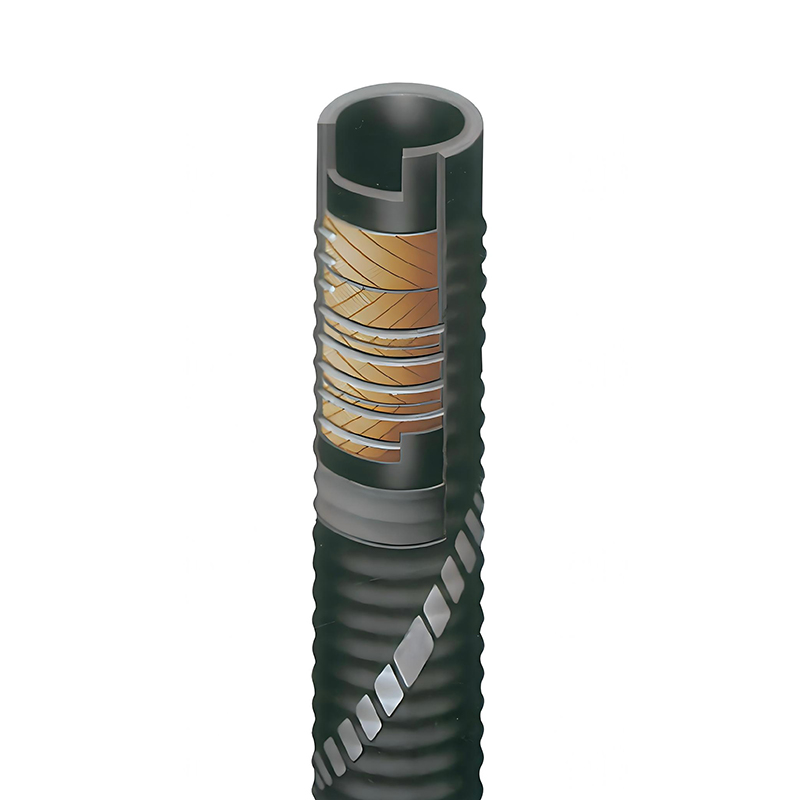
A typical assembly combines a drilling-fluid-compatible inner tube, high-strength reinforcement, a protective outer cover, high-pressure hose couplings and pressure-rated end connectors.
Pressure rating is only one part of the selection process. Pulsation, abrasive drilling fluid, temperature, routing and connection loading can also affect hose performance.
API 7K Mud Jumper Hose Applications
Mud Manifold Jumper Hose
A Mud Manifold Jumper Hose provides flexibility between compatible high-pressure manifold sections where rigid piping cannot easily follow the required geometry.
Common installations include manifold inlet or outlet crossovers, manifold-to-manifold connections and replacement sections after a piping or manifold modification.
Project RFQs may also describe this application as a Mud Manifold Hose, High Pressure Mud Manifold Hose, Flexible Manifold Hose or Mud Manifold Crossover Hose.
High-Pressure Surface Mud Lines
A High Pressure Mud Line Hose provides a flexible section within the surface drilling fluid system.
Applications include surface mud line crossovers, drilling fluid distribution lines, auxiliary circulation connections and replacement sections in existing mud systems.
Related long-tail terms include Mud Delivery Hose, Mud Circulation Hose, Flexible Mud Line, High Pressure Drilling Fluid Hose, Oilfield Mud Line Hose and Drilling Rig Mud Hose.
Standpipe Manifold Fixed Crossovers
Some drilling rigs need a fixed-to-fixed flexible connection near the standpipe manifold.
A Mud Jumper Hose can suit this position when the hose does not travel continuously like a Rotary Hose and does not primarily absorb direct mud pump vibration like a Vibrator Hose.
Because several API 7K hose types can operate around the mud pump and standpipe system, a piping diagram or installation photograph is useful when the required hose type is unclear.
Mud Circulation Packages and Rig Retrofits
Modern drilling rigs often use modular mud circulation packages with different elevations, connection directions and center distances.
A Custom Mud Jumper Hose can bridge compatible fixed equipment without rebuilding a long rigid crossover.
This is also useful during rig upgrades. If a replacement manifold or drilling fluid package changes the connection position, the hose length and Side A / Side B connections can be configured around the new layout.
Land and Offshore Drilling Applications
Land rigs use high-pressure flexible mud connections around manifolds, surface mud lines and circulation equipment.
Offshore drilling adds other considerations, including deck abrasion, hose support, environmental exposure, minimum bend radius, connection loading and equipment movement.
SGPE supports Land Rig Mud Hose, Offshore High Pressure Mud Hose, Offshore Drilling Mud Hose, Jack-Up Rig Mud Hose, Drillship Mud Hose and Offshore Mud Manifold Hose requirements according to the actual application.
Mud Jumper Hose vs Vibrator Hose vs Rotary Hose
The general term API 7K Drilling Hose can refer to several hose types, but their installation positions and mechanical duties differ.
| Hose Type | Typical Installation | Main Duty | Key Selection Concern |
| Mud Jumper Hose | Between compatible fixed sections of the surface mud system | Flexible high-pressure mud transfer | Pressure, length, MBR and connection geometry |
| API 7K Vibrator Hose | Mud pump discharge to standpipe/manifold arrangement | Transfers mud while accommodating pump vibration | Vibration and pressure pulsation |
| API 7K Rotary Hose / Kelly Hose | Standpipe to swivel or Top Drive | Transfers drilling mud into the moving drill string | Continuous flexing and traveling movement |
If an RFQ simply states Mud Pump Hose, confirm the installation position first.
A hose from the mud pump discharge to the standpipe can require an API 7K Vibrator Hose. A hose from the standpipe to the swivel or Top Drive requires an API 7K Rotary Hose / Kelly Hose. A flexible crossover between compatible fixed sections of the surface mud system can require a Mud Jumper Hose.
API 7K Mud Jumper Hose vs API 16C Choke and Kill Hose
An API 7K Mud Jumper Hose does not replace an API 16C Choke and Kill Hose.
| Item | API 7K Mud Jumper Hose | API 16C Choke and Kill Hose |
| Main System | Drilling mud circulation | Well control |
| Main Function | Flexible high-pressure mud transfer | Choke and kill fluid service |
| Typical Location | Surface mud circulation system | BOP, choke manifold and kill manifold |
| Main Selection | Pressure, FSL, flow, temperature and routing | Well-control pressure, temperature, media and project requirements |
| Standard | API Spec 7K | API Spec 16C |
If the hose connects to a BOP stack, choke manifold or kill manifold, identify the exact service before requesting a quotation.
High-Pressure Mud Jumper Hose Construction
Drilling-Fluid-Compatible Inner Tube
The inner tube contacts the drilling fluid directly.
Mud type, base fluid, operating temperature, abrasive solids and chemical additives can affect compatibility. Water-based, oil-based and synthetic-based mud systems therefore need to be checked against the qualified hose construction.
Providing the actual drilling fluid specification gives a better basis for selection than a general description such as “oil mud” or “water mud.”
High-Strength Reinforcement
The reinforcement contains internal pressure and supports mechanical loading.
Its construction depends on hose ID, working pressure, FSL, temperature qualification and the qualified hose design.
Two hoses with the same nominal bore can therefore use different constructions when their pressure or service conditions differ.
Protective Outer Cover
The outer cover helps protect the hose from drilling mud, hydraulic oil, hydrocarbons, sunlight, ozone, weather and contact with rig structures.
Land and offshore installations can have very different abrasion and environmental conditions, so the protective configuration should match the actual project.
API 7K Mud Jumper Hose End Connections
Side A and Side B can be configured around the actual rig equipment.
| End Connection | Typical Oilfield Application | Information Required |
| Hammer Union | High-pressure drilling mud line | Size, Fig. number and pressure |
| Fig. 1002 Style End | Compatible mud circulation system | Size and mating union |
| Fig. 1502 Style End | High-pressure mud line | Size, pressure and orientation |
| Flanged End | Mud manifold or drilling equipment | Size, pressure class and flange details |
| Hub-Type End | Compact high-pressure connection | Hub specification |
| Integral End Connector | Higher-pressure qualified assembly | Connector and mating equipment details |
| Butt-Welded End Connector | Higher-pressure hose assembly | Connector specification |
| Custom Adapter End | Retrofit and replacement crossover | Side A / Side B details or drawings |
The two ends do not need to be identical. Different compatible connections are often useful for Custom Mud Jumper Hose, Replacement Mud Hose Assembly, Mud Manifold Crossover Hose and rig retrofit projects.
Fig. 1502 and Fig. 1002 Mud Jumper Hose Connections
A Fig. 1502 Mud Hose is a common high-pressure oilfield procurement requirement. Selected drilling mud systems also use Fig. 1002 style ends.
However, the Fig. number alone is not enough to specify the complete assembly.
A correct RFQ should also identify the nominal union size, hose ID, working pressure, API grade, FSL, connection orientation, overall length, drilling fluid, temperature and installation position.
For example:
3 in. API 7K Grade D Mud Jumper Hose, 5000 PSI, FSL 2, Fig. 1502 Ends
still requires confirmation of the Side A / Side B arrangement and finished hose length.
For replacement hoses, clear connection photographs or drawings help reduce specification errors.
End Connector Requirements Above 5000 PSI
For hose assemblies rated above 5,000 PSI / 34.5 MPa, the end connector cannot attach to the hose coupling through an API 5B line-pipe-thread connection.
A suitable higher-pressure hose design instead uses an integral or butt-welded end connector arrangement.
This restriction applies to the interface between the hose coupling and end connector. It does not mean that every threaded component elsewhere in the drilling mud system is unsuitable.
Drilling Mud Compatibility and Sour Service
A Mud Jumper Hose can carry compatible water-based, oil-based or synthetic-based drilling fluids when its construction suits the actual fluid chemistry and operating temperature.
For accurate selection, provide the mud type, base fluid, normal and maximum temperature, density and relevant additives where available.
If the project involves H2S or another defined sour-service environment, also identify the service conditions, metallic connector requirements and applicable NACE MR0175 / ISO 15156 requirements where relevant.
A standard Mud Jumper Hose specification should not automatically be treated as a sour-service specification.
Mud Jumper Hose Length and Routing
Correct length is important for both installation and hose performance.
For assemblies up to 6 m / 20 ft, the finished unpressurized length tolerance is ±65 mm / ±2-1/2 in.
For assemblies longer than 6 m / 20 ft, the tolerance must remain within ±1%.
A hose that is too short can create axial tension, tight bending and high coupling loads. An overly long hose can sag, rub against rig structures and form poor bend geometry.
The installation must also remain above the specified Minimum Bend Radius.
For replacement or restricted-space projects, provide the connection distance, end orientation, installation drawing or site photographs before finalizing hose length.
API 7K Testing, Inspection and Documentation
High-pressure drilling hose procurement involves more than checking dimensions.
| Requirement | Technical Reference | Procurement Value |
| Production Hydrostatic Test | 1.5 × rated working pressure | Confirms the finished hose assembly under pressure |
| Test Medium | Water | Production hydrostatic test medium |
| Minimum Test Hold Time | 15 minutes | Provides controlled pressure verification |
| Minimum Burst Design | 2.5 × rated working pressure | High-pressure mud hose design requirement |
| Pressure-Induced Deformation | Controlled within the applicable qualified limit | Verifies deformation under pressure |
| Bending Verification | According to qualified hose design and MBR | Verifies bending performance |
| Low-Temperature Verification | According to qualified minimum temperature | Confirms cold-temperature performance |
| FSL Verification | According to applicable FSL design requirements | Supports hose design qualification |
| Hose Identification | Pressure, temperature, FSL and manufacturing information | Supports traceability and field identification |
Design verification applies to the qualified hose design, while production hydrostatic testing applies to the finished assembly.
According to the purchase specification, SGPE can coordinate hydrotest records, dimensional inspection, hose identification, applicable material records, COC and third-party inspection documentation.
Custom and Replacement API 7K Mud Jumper Hose
A replacement hose enquiry does not always come with a complete original data sheet.
SGPE can review an existing hose from its nameplate, body marking, photographs, end connections, overall dimensions, piping drawing or previous purchase specification.
This helps procurement teams source a Replacement API 7K Mud Jumper Hose when the original part number is unavailable.
Custom assemblies are also useful when a new manifold changes the connection elevation, Side A and Side B use different compatible connections, or a standard hose length does not fit the actual rig.
For OEM and drilling equipment package projects, project marking, connection, inspection and documentation requirements can also be reviewed before production.
API 7K Mud Jumper Hose Price and Quotation Factors
The final API 7K Mud Jumper Hose price depends on the complete assembly rather than hose diameter alone.
| Quotation Factor | Why It Matters |
| Pressure Grade | Grade D and Grade E use different pressure designs |
| Hose ID | Bore size affects hose construction and material requirements |
| FSL | Service level affects the qualified hose design |
| Temperature Range | Temperature qualification affects hose selection |
| Overall Length | Longer assemblies increase hose and reinforcement requirements |
| End Connections | Unions, flanges, hubs and adapters change the final configuration |
| Side A / Side B | Different ends can require additional engineering or machining |
| Drilling Fluid | Fluid compatibility affects inner-tube selection |
| Sour Service | H2S requirements can affect metallic components |
| Safety Accessories | Restraints and abrasion protection add project scope |
| Third-Party Inspection | TPI and hold points affect inspection planning |
| Documentation | MDR and project-specific records affect document scope |
| Quantity | Operating and spare quantities affect commercial terms |
For an accurate API 7K Mud Jumper Hose quote, send the technical specification rather than requesting a generic price based only on hose size.
Why Choose SGPE as Your API 7K Mud Jumper Hose Supplier?
SGPE focuses on oilfield drilling equipment and project-specific operating conditions. A high-pressure drilling hose should not be selected like a generic industrial hose.
Our technical review starts with the installation position. This helps determine whether the project requires a Mud Jumper Hose, API 7K Vibrator Hose, Rotary Hose or another high-pressure hose type.
SGPE supports Grade D 5000 PSI and Grade E 7500 PSI Mud Jumper Hose requirements for land and offshore projects. Hose bore, FSL, temperature, drilling mud compatibility, overall length and connection geometry are reviewed together before the configuration is finalized.
Project options include Fig. 1002 and Fig. 1502 style ends, hammer unions, flanges, hubs, integral connectors, butt-welded connectors and custom crossover adapters.
For replacement projects, an existing nameplate, hose marking, photographs or dimensions can often provide enough information for the first technical review.
SGPE can also coordinate hydrotest records, inspection documentation, COC, applicable material records, third-party inspection and agreed project documents.
For drilling contractors and procurement teams looking for an API 7K Mud Jumper Hose manufacturer or supplier in China, SGPE provides project-based technical review rather than quoting from nominal hose size alone.
Information Required for an API 7K Mud Jumper Hose Quote
A complete RFQ helps reduce technical clarification and shortens the quotation process.
| RFQ Item | Information to Provide |
| Hose ID | Required internal diameter |
| Working Pressure | Maximum continuous operating pressure |
| API Grade | Grade C, D or E |
| FSL | FSL 1 or FSL 2 |
| Temperature Range | Required hose temperature classification |
| Overall Length | Required end-to-end length |
| Side A Connection | Type, size, pressure and orientation |
| Side B Connection | Type, size, pressure and orientation |
| Drilling Fluid | Water-based, oil-based, synthetic-based or other compatible fluid |
| Mud Temperature | Normal and maximum operating temperature |
| Ambient Temperature | Minimum and maximum site temperature |
| Installation Position | Exact location within the mud circulation system |
| Rig Type | Land rig, jack-up, semi-submersible or drillship |
| Available Bend Radius | Actual routing space |
| Movement | Fixed, alignment offset or controlled movement |
| Sour Service | H2S / NACE requirement if applicable |
| Safety Accessories | Restraints, abrasion protection or other requirements |
| Quantity | Operating quantity and spare quantity |
| Inspection | Customer or third-party inspection requirements |
| Documentation | Data sheet, hydrotest record, COC, material records or MDR |
For replacement hoses, also send the existing hose nameplate, body marking, connection photographs, overall dimensions or drilling mud system drawing.
Frequently Asked Questions About API 7K Mud Jumper Hoses
1. What is an API 7K Mud Jumper Hose and where is it used?
An API 7K Mud Jumper Hose transfers drilling mud between compatible fixed sections of the surface mud circulation system. Unlike a Rotary Hose, which moves with the traveling equipment, or a Vibrator Hose, which works around the mud pump discharge system, a Mud Jumper Hose mainly serves fixed-to-fixed flexible crossover applications.
Typical installations include high-pressure mud manifold crossovers, surface mud lines, fixed standpipe manifold connections, auxiliary drilling fluid lines and modular mud circulation packages. Rig upgrade projects also use Mud Jumper Hoses when new equipment changes the original piping alignment.
Depending on the project, procurement documents may also call this product a Drilling Mud Jumper Hose, High Pressure Mud Hose, Mud Manifold Hose, Mud Circulation Hose, Mud Delivery Hose or Flexible Mud Line Hose.
When selecting a hose, review the working pressure, FSL, hose ID, drilling fluid, temperature, overall length, minimum bend radius and both end connections.
2. What is the difference between an API 7K Mud Jumper Hose and an API 7K Vibrator Hose?
The main difference comes from the installation position and mechanical duty.
An API 7K Mud Jumper Hose normally connects compatible fixed sections of a surface drilling mud system. Common examples include mud manifold crossovers, fixed standpipe manifold connections and flexible connections between drilling fluid packages.
An API 7K Vibrator Hose normally connects the mud pump discharge system with the standpipe or associated manifold. Its location exposes the hose more directly to mud pump vibration and pressure pulsation.
A fixed high-pressure mud line crossover generally requires a Mud Jumper Hose, while a direct mud pump discharge connection generally requires a Vibrator Hose.
Both hose types can operate within the same drilling mud circulation system, so always confirm the installation position before ordering. If the hose type remains unclear, send SGPE a piping drawing or installation photo so we can review the application.
3. Is an API 7K Mud Jumper Hose the same as a Rotary Hose or Kelly Hose?
No. All three products fall within the broader API 7K Drilling Hose category, but they serve different parts of the drilling mud system.
An API 7K Rotary Hose, also called a Kelly Hose or Top Drive Rotary Hose, normally connects the standpipe to the swivel or Top Drive. It flexes continuously as the traveling equipment moves vertically during drilling.
A Mud Jumper Hose normally connects compatible fixed sections of the surface mud system. Typical applications include high-pressure mud manifold connections, surface mud lines, drilling fluid package crossovers and fixed standpipe manifold sections.
This difference matters when sourcing a replacement hose. If you order only by hose diameter and pressure rating, you can easily select the wrong hose type.
SGPE therefore recommends confirming the installation position, working pressure, expected movement and end connections before choosing a Mud Jumper Hose, Rotary Hose or Vibrator Hose.
4. What pressure ratings are available for API 7K Mud Jumper Hose?
The main pressure grades covered on this page include Grade C at 4,000 PSI / 27.6 MPa, Grade D at 5,000 PSI / 34.5 MPa and Grade E at 7,500 PSI / 51.7 MPa.
SGPE mainly supplies Grade D 5000 PSI Mud Jumper Hose and Grade E 7500 PSI Mud Jumper Hose assemblies for commercial drilling projects.
Grade D commonly serves high-pressure mud manifolds, surface mud lines and drilling fluid circulation systems. Grade E supports higher-pressure mud circulation applications, including selected offshore drilling projects.
Do not select the hose pressure rating in isolation. Hammer unions, flanges, hubs, adapters and mating equipment must also carry a compatible pressure rating because the lowest-rated pressure-containing component limits the complete assembly.
For a new or replacement High Pressure Mud Hose, provide the maximum working pressure, API grade, hose ID, FSL, temperature and end connection details so SGPE can review the complete pressure system.
5. What is the difference between Grade D 5000 PSI and Grade E 7500 PSI Mud Jumper Hose?
The main difference lies in the rated working pressure and the hose configuration required for that pressure level.
A Grade D 5000 PSI Mud Jumper Hose carries a rated working pressure of 5,000 PSI / 34.5 MPa. The size combinations shown on this page cover 2 in. through 6 in. Grade D commonly serves high-pressure mud manifold crossovers, surface mud lines and drilling fluid distribution systems.
A Grade E 7500 PSI Mud Jumper Hose carries a rated working pressure of 7,500 PSI / 51.7 MPa. The size combinations listed here start at 2-1/2 in. Grade E suits higher-pressure drilling mud circulation, including selected offshore and high-pressure surface mud systems.
Because Grade E operates above 5,000 PSI, the hose coupling and end connector require a suitable higher-pressure interface.
Choose the grade according to actual system pressure, hose ID, FSL, temperature, routing and end connection requirements rather than simply choosing the higher pressure rating.
6. What is the difference between FSL 1 and FSL 2 Mud Jumper Hose?
FSL means Flexible Specification Level and helps define the hose requirements for different drilling service conditions.
An FSL 1 Mud Jumper Hose suits normal jumper hose service. An FSL 2 Mud Jumper Hose suits applications that can experience high-frequency pressure pulsations with amplitudes above 1,000 PSI / 6.9 MPa.
Working pressure alone does not determine the correct FSL. Mud pump characteristics, pump speed, drilling fluid properties, flow rate and surface piping geometry can all influence pressure pulsation.
For example, two 5000 PSI Mud Jumper Hose assemblies can carry the same working pressure but operate under very different pulsation conditions. One project may need FSL 1, while another may require FSL 2.
For land rigs, offshore drilling systems and high-pulsation mud circulation applications, SGPE recommends reviewing FSL together with pressure grade, temperature, hose ID and installation position.
7. What sizes are available for API 7K Mud Jumper Hose?
Common API 7K Mud Jumper Hose sizes include 2 in., 2-1/2 in., 3 in., 3-1/2 in., 4 in., 5 in. and 6 in. hose IDs. However, each pressure grade covers a different range of size combinations.
The Grade D combinations shown on this page cover 2 in. through 6 in., while Grade E starts at 2-1/2 in.
Select the hose ID according to the drilling mud flow requirement, pressure grade, existing line bore, FSL and available minimum bend radius.
Do not use the connection size alone to determine the hose ID. A large hammer union or flange does not automatically require the same hose bore.
This becomes especially important for mud manifold crossover hoses, high-pressure surface mud lines and rig retrofit projects, where the existing equipment may use different connection and bore sizes.
For preliminary selection, send SGPE the required flow rate, working pressure, existing pipe size, end connection details and available routing space.
8. What end connections are available for API 7K Mud Jumper Hose?
SGPE can configure an API 7K Mud Jumper Hose with several oilfield end connection types according to the mating equipment and pressure requirement.
Common options include Fig. 1002 and Fig. 1502 Mud Hose ends, hammer unions, flanges, hubs, integral connectors, butt-welded connectors and custom crossover adapters.
Side A and Side B do not need to use identical connections. This flexibility helps with mud manifold crossover connections, equipment retrofits and replacement hose projects.
When specifying the ends, provide more than the connection name. SGPE also needs the size, Fig. number, pressure rating, orientation and mating equipment details.
For hose assemblies above 5,000 PSI / 34.5 MPa, the hose coupling and end connector cannot use an API 5B line-pipe-thread attachment at that interface.
For a Replacement Mud Jumper Hose, clear photographs of both ends, hose markings and overall dimensions help SGPE confirm the correct connection arrangement.
9. Can SGPE supply custom or replacement API 7K Mud Jumper Hose assemblies?
Yes. SGPE supplies both Custom API 7K Mud Jumper Hose and Replacement Mud Jumper Hose assemblies for drilling rigs, mud manifolds and surface drilling fluid systems.
Replacement enquiries often arrive without the original technical data sheet or part number. In many cases, SGPE can review the existing hose by checking its nameplate, body marking, working pressure, FSL, overall length, end connections, photographs and installation position.
Custom configurations also help during rig upgrades or equipment replacement. For example, a new mud manifold or circulation package can change the connection elevation, center distance or end orientation.
In that case, SGPE can configure a custom-length Mud Jumper Hose with different Side A and Side B connections to bridge the new layout without rebuilding a long section of rigid piping.
SGPE can also review project-specific marking, inspection and documentation requirements for OEM packages and drilling equipment projects.
10. Can an API 7K Mud Jumper Hose handle water-based, oil-based or synthetic-based drilling mud?
An API 7K Mud Jumper Hose can carry compatible water-based, oil-based or synthetic-based drilling fluids when the hose construction matches the actual fluid chemistry and operating temperature.
The inner tube remains in direct contact with the drilling fluid, so mud type, base fluid, temperature, abrasive solids and chemical additives can affect compatibility and service performance.
For drilling mud circulation projects, SGPE recommends providing the mud type, base fluid, normal and maximum operating temperature, density and relevant chemical information where available.
This information becomes especially important for oil-based mud, synthetic-based mud and high-temperature drilling applications.
If the system contains H2S or operates under another sour-service condition, also identify the service environment, metallic connector material requirements and applicable NACE MR0175 / ISO 15156 requirements where relevant.
Do not assume that a standard High Pressure Mud Hose automatically meets sour-service requirements.
11. How should I select the length and minimum bend radius of a Mud Jumper Hose?
Choose the hose length according to the actual rig layout, connection distance, end orientation and available routing space.
A Mud Jumper Hose that is too short can create axial tension, tight bending and excessive loads near the couplings. A hose that is too long can sag, rub against rig structures and form poor bend geometry.
Always keep the hose above its specified Minimum Bend Radius, or MBR.
For the Grade C, Grade D and Grade E combinations shown on this page, reference MBR values range from approximately 0.9 m / 36 in. to 1.8 m / 72 in., depending on hose ID and pressure grade.
Length selection becomes especially important for mud manifold jumper hoses, fixed standpipe crossovers, offshore mud lines and rig retrofit projects, where routing space can be limited.
For replacement applications, send SGPE the existing hose length, connection distance, end orientation and installation photographs before confirming the final assembly.
12. What information does SGPE need to prepare an API 7K Mud Jumper Hose quotation?
SGPE prepares an accurate API 7K Mud Jumper Hose quotation from the actual operating and installation conditions rather than from hose diameter alone.
Please provide the hose ID, working pressure, API grade, FSL, temperature range, overall length and Side A / Side B connection details.
Also include the drilling fluid, normal and maximum temperature, installation position, available bend radius, rig type and any H2S or sour-service requirement where applicable.
For land rigs, offshore platforms, jack-up rigs, semi-submersibles and drillships, piping drawings or installation photographs help SGPE understand the connection geometry and routing more quickly.
For a Replacement API 7K Mud Jumper Hose, the existing nameplate, body marking, end connection photographs and overall dimensions can usually provide enough information for the first technical review.
After SGPE confirms the application and technical requirements, we can prepare the suitable hose configuration, technical proposal and commercial quotation for your project.
Request an API 7K Mud Jumper Hose Quote from SGPE
Need an API 7K Mud Jumper Hose for a land rig, offshore drilling rig, mud manifold, surface mud line or rig retrofit project?
SGPE supplies Grade D 5000 PSI and Grade E 7500 PSI Mud Jumper Hose assemblies with FSL 1 or FSL 2, Fig. 1002, Fig. 1502, custom lengths and replacement configurations.
Email: info@sgpe.com
Tel / WhatsApp: +86 186-1599-5239