Description
API 7K Vibrator Hose for Mud Pump-to-Standpipe High-Pressure Mud Systems
SGPE manufactures API 7K Vibrator Hose assemblies for high-pressure drilling mud circulation systems on land rigs, offshore platforms, jack-up rigs, semi-submersibles, drillships and workover units.
Also known as a Drilling Vibrator Hose, Mud Vibrator Hose, High Pressure Mud Hose, Mud Pump Vibrator Hose or Mud Pump Discharge Hose, this flexible hose is normally installed between the mud pump discharge or pump manifold and the standpipe manifold.
Reciprocating mud pumps create vibration and repeated pressure pulsation during circulation. The vibrator hose provides a flexible section between the pump and rigid downstream piping, carrying drilling mud at high pressure while reducing the direct transfer of dynamic loads into the standpipe system.
SGPE supplies vibrator hoses for new drilling rigs, mud pump upgrades, standpipe manifold modifications, rig refurbishment, rig reactivation and replacement API 7K Vibrator Hose projects. Final configuration is based on hose ID, working pressure, Grade, FSL, temperature, drilling fluid, overall length, minimum bend radius and end connections.
Reference requirements cover approximately 2 in. to 6 in. hose ID. Grade D 5000 PSI Vibrator Hose and Grade E 7500 PSI Vibrator Hose are common configurations, while selected higher-pressure applications require project-specific technical confirmation.
Connection and accessory options include Fig. 1002 Hammer Unions, Fig. 1502 Hammer Unions, flanged ends, hub ends, mixed End A / End B connections, custom lengths, safety restraints and external abrasion protection.
API 7K Vibrator Hose Quick Specifications
| Technical Item | SGPE Reference / Project Option |
|---|---|
| Product | API 7K Vibrator Hose |
| Product Category | High-Pressure Oilfield Drilling Mud Hose |
| Manufacturer / Supplier | SGPE |
| Applicable Specification | API Spec 7K, applicable project-specified edition |
| Related Product Terms | Drilling Vibrator Hose, Mud Vibrator Hose, High Pressure Mud Hose, Mud Pump Hose, Mud Pump Discharge Hose |
| Main Function | High-pressure mud transfer, vibration isolation and pressure-pulsation accommodation |
| Typical Installation | Mud pump discharge / pump manifold to standpipe manifold |
| Reference Hose ID | Approx. 2–6 in., depending on hose construction |
| Common Sizes | 2 in., 2-1/2 in., 3 in., 3-1/2 in., 4 in., 5 in., 6 in. |
| Common Working Pressure | 5,000 psi / 7,500 psi |
| Higher-Pressure Projects | 10,000 psi / 15,000 psi subject to technical confirmation |
| Reference Grades | Grade D / Grade E / project-specific higher grades |
| Flexible Specification Level | FSL 1 / FSL 2 |
| Fluid Service | Water-based mud, oil-based mud and compatible drilling fluids |
| Inner Tube | Drilling-fluid-resistant synthetic elastomer selected for service |
| Reinforcement | Multiple layers of high-strength steel wire or steel cable |
| Outer Cover | Abrasion-, oil-, weather- and ozone-resistant elastomer |
| Overall Length | Customized according to rig layout |
| Minimum Bend Radius | According to approved hose construction and datasheet |
| End Connections | Hammer Union / Flange / Hub / Custom |
| Hammer Union Options | Fig. 1002 / Fig. 1502 / Project-specific |
| End Orientation | Male × Female / Male × Male / Female × Female / Mixed |
| Safety Accessories | Safety clamps, restraint cable/chain, shackles and lifting eyes |
| External Protection | Optional armor or abrasion guard |
| Hydrostatic Testing | According to approved technical and project requirements |
| Inspection | Dimensional, visual and end-connection inspection |
| Third-Party Inspection | Available where specified |
| Documentation | Pressure-test report, inspection records and agreed project documents |
| Typical Buyers | Drilling contractors, rig owners, EPC contractors, oilfield service companies and distributors |
API 7K Vibrator Hose Manufacturer & Supplier – SGPE
For a buyer sourcing an API 7K Vibrator Hose manufacturer or supplier, working pressure alone does not define the correct hose.
The assembly must also match the hose bore, Grade, FSL, drilling fluid, operating temperature, installed length, minimum bend radius and End A / End B interfaces.
These details directly affect field installation. A hose with the correct pressure rating can still be unsuitable if its length creates an excessive bend, its Hammer Union orientation does not match the manifold or its liner is incompatible with the drilling fluid.
SGPE handles both new-build and replacement requirements. Where the original datasheet is unavailable, existing hose nameplates, layline markings, dimensions, connection photographs and rig drawings can be used to establish the required replacement specification.
International orders can also include agreed hydrostatic testing, dimensional inspection, third-party inspection, export packing and project documentation.
What Is an API 7K Vibrator Hose?
An API 7K Vibrator Hose is a flexible high-pressure drilling hose positioned between the mud pumping system and rigid standpipe piping.
A typical drilling mud circulation path is:
Mud Pump → Mud Pump Discharge / Manifold → API 7K Vibrator Hose → Standpipe Manifold → Standpipe → API 7K Rotary Hose → Top Drive or Swivel → Drill String
The mud pump produces repeated vibration and pressure pulses. Without a flexible connection, more of these dynamic loads would pass directly into rigid piping, valves, fittings and support structures.
The vibrator hose provides that flexible connection while transferring high-pressure drilling mud and accommodating limited relative movement between connected equipment.
Depending on the drilling contractor, rig manufacturer or procurement terminology, the product may also be described as an API 7K High Pressure Mud Hose, API 7K Drilling Hose, Mud Pump Flexible Hose, Mud Pump Connector Hose, Mud Pump to Standpipe Hose, Standpipe Manifold Hose, Oilfield Vibrator Hose or High Pressure Mud Pump Hose.
The term Rotary Vibrator Hose is also used commercially as a broader hose-category description. However, a pump-side Vibrator Hose and a standpipe-to-Top-Drive Rotary Hose perform different functions, so the installation position should always be confirmed before ordering.
API 7K Vibrator Hose Technical Parameters
| Parameter | Reference Requirement / Selection |
| Product | API 7K Vibrator Hose |
| Product Type | High Pressure Mud Hose / Drilling Vibrator Hose |
| Manufacturer | SGPE |
| Primary Service | High-pressure drilling mud circulation |
| Typical Position | Mud pump / pump manifold to standpipe manifold |
| Applicable Specification | API Spec 7K |
| Hose ID | Approx. 2–6 in., depending on construction |
| Working Pressure | Common 5,000 / 7,500 psi; higher requirements subject to confirmation |
| Pressure Grade | Grade D / Grade E / project-specific higher grades |
| FSL | FSL 1 / FSL 2 |
| Operating Temperature | According to selected liner and complete hose construction |
| Inner Tube | NBR, HNBR or project-selected compatible elastomer |
| Bore | Smooth bore / project-specific full-bore construction |
| Reinforcement | Multiple high-tensile steel wire or steel cable layers |
| Outer Cover | Heavy-duty synthetic elastomer |
| Cover Resistance | Abrasion, oil, weather, ozone and wellsite exposure |
| Overall Length | Customized |
| Length Definition | Overall / end-to-end / face-to-face to be confirmed |
| Minimum Bend Radius | Configuration-specific |
| Pressure-Induced Length Change | Consider during installed-length selection |
| End Coupling | High-pressure coupling matched to hose construction |
| End Connections | Hammer Union / Flange / Hub / Custom |
| Hammer Union Figure | Fig. 1002 / Fig. 1502 / project-specific |
| End Orientation | M × F / M × M / F × F / Mixed |
| Water-Based Mud | Compatible construction subject to fluid review |
| Oil-Based Mud | Liner selected according to actual fluid |
| High-Density Mud | Mud density and operating data should be provided |
| Abrasive Mud | Solids content and flow velocity should be considered |
| Sour / H2S Conditions | Declare during RFQ for material review |
| Safety Clamp / Restraint | Project-specific |
| Lifting Eye | Optional where required |
| External Protection | Optional armor or abrasion guard |
| Hydrostatic Test | According to approved hose and project requirements |
| Dimensional Inspection | Hose length and end-configuration verification |
| Marking | According to applicable specification and project requirement |
| Traceability | Project-specific identification and documentation |
| Third-Party Inspection | Available where specified |
| Packing | Export packing suitable for heavy oilfield hose assemblies |
API 7K Vibrator Hose Pressure Grades
Working pressure is one of the first parameters buyers compare when requesting an API 7K Vibrator Hose quotation, but pressure must be evaluated together with hose ID, FSL, temperature, drilling fluid, overall length, end connections and installation geometry.
| Reference Grade | Working Pressure | Reference Factory Test* | Typical RFQ Description |
| Grade D | 5,000 psi / 34.5 MPa | 7,500 psi / 51.7 MPa | 5000 PSI Vibrator Hose / Grade D Mud Hose |
| Grade E | 7,500 psi / 51.7 MPa | 11,250 psi / 77.6 MPa | 7500 PSI Vibrator Hose / Grade E Mud Hose |
| Grade F | 10,000 psi / approx. 69 MPa | Project-specific | 10000 PSI Vibrator Hose |
| Grade G | 15,000 psi / approx. 103 MPa | Project-specific | 15000 PSI API 7K Hose |
*Reference values are for preliminary selection only. Final factory-test requirements follow the approved hose datasheet and project specification.
Grade D 5000 PSI Vibrator Hose
A 5000 PSI API 7K Vibrator Hose is widely used in conventional mud pump discharge systems.
Common RFQ descriptions include Grade D Vibrator Hose, API 7K Grade D Hose, 5000 PSI Mud Hose, 5000 PSI Mud Pump Hose and Grade D Mud Pump Discharge Hose.
The final assembly should combine the 5,000 psi working-pressure requirement with the correct hose ID, FSL, temperature, drilling fluid, overall length, MBR and end connections.
Grade E 7500 PSI Vibrator Hose
A 7500 PSI API 7K Vibrator Hose is used in higher-pressure drilling mud circulation systems.
Typical purchasing descriptions include Grade E Vibrator Hose, API 7K Grade E Hose, 7500 PSI Mud Hose, 7500 PSI Mud Pump Hose and FSL 2 Grade E Vibrator Hose.
Higher-pressure hose construction can increase assembly OD and weight. Minimum bend radius, lifting arrangements, structural support and available rig clearance therefore become more important during selection.
10000 PSI and 15000 PSI Requirements
Selected drilling projects specify 10000 PSI Vibrator Hose or 15000 PSI API 7K Hose requirements.
These higher-pressure applications require project-specific technical confirmation. Hose ID, FSL, drilling fluid, temperature, connections, rig layout, inspection scope and documentation all affect the final assembly.
Industry Reference Dimensions for Grade D & Grade E Vibrator Hose
The following API 7K Vibrator Hose dimensions are industry reference values for preliminary hose selection, rig-layout planning and replacement comparison.
Final OD, Minimum Bend Radius (MBR) and hose weight can vary with hose construction, liner, reinforcement, FSL, coupling design and end connections. Always confirm the approved project datasheet before final selection.
| Grade | Hose ID | WP | Test Pressure | Reference OD | Reference MBR | Approx. Weight |
|---|---|---|---|---|---|---|
| D | 2 in. | 5,000 psi | 7,500 psi | 92 mm | 0.9 m | 11.0 kg/m |
| D | 2-1/2 in. | 5,000 psi | 7,500 psi | 104 mm | 0.9 m | 12.8 kg/m |
| D | 3 in. | 5,000 psi | 7,500 psi | 121 mm | 1.2 m | 17.7 kg/m |
| D | 3-1/2 in. | 5,000 psi | 7,500 psi | 133 mm | 1.4 m | 20.0 kg/m |
| D | 4 in. | 5,000 psi | 7,500 psi | 146 mm | 1.4 m | 22.15 kg/m |
| D | 5 in. | 5,000 psi | 7,500 psi | 197 mm | 1.5 m | 53.1 kg/m |
| D | 6 in. | 5,000 psi | 7,500 psi | 222 mm | 1.8 m | 61.2 kg/m |
| E | 2-1/2 in. | 7,500 psi | 11,250 psi | 131 mm | 1.2 m | 31.0 kg/m |
| E | 3 in. | 7,500 psi | 11,250 psi | 142 mm | 1.2 m | 34.9 kg/m |
| E | 3-1/2 in. | 7,500 psi | 11,250 psi | 154 mm | 1.4 m | 38.8 kg/m |
| E | 4 in. | 7,500 psi | 11,250 psi | 188 mm | 1.5 m | 61.8 kg/m |
| E | 5 in. | 7,500 psi | 11,250 psi | 206 mm | 1.8 m | 63.8 kg/m |
These values highlight an important selection point: hose ID and working pressure alone are not enough. Larger and higher-pressure vibrator hoses require more bending clearance, structural support and installation space.
Common API 7K Vibrator Hose Sizes
API 7K Vibrator Hose requirements commonly range from approximately 2 in. to 6 in. ID.
A 2 in. or 2-1/2 in. hose can suit compact or project-specific mud systems. 3 in., 3-1/2 in. and 4 in. Vibrator Hoses are common in mud pump discharge and standpipe manifold applications, while 5 in. and 6 in. assemblies need closer review of flow, MBR, support and available space.
Typical inquiries include a 3 Inch API 7K Vibrator Hose at 5000 PSI, a 3-1/2 Inch Grade D Vibrator Hose, a 3-1/2 Inch Grade E 7500 PSI Vibrator Hose or a 4 Inch Mud Pump Discharge Hose with project-specific end connections.
The largest bore is not automatically the best choice. Pump output, required flow, drilling-fluid properties, working pressure, connection size, minimum bend radius and available rig space should be considered together.
FSL 1 vs FSL 2 API 7K Vibrator Hose
| FSL | Service Condition | Selection Logic |
| FSL 1 | Normal rotary, vibrator and jumper hose service | Used where severe high-frequency pulsation does not dominate the application |
| FSL 2 | High-frequency pressure-pulsation service | Used where pulsation amplitudes can exceed 1,000 psi / 6.9 MPa |
FSL 1 covers rotary, vibrator and jumper hose applications intended for normal service under the applicable project requirement.
An API 7K FSL 2 Vibrator Hose addresses more severe pressure-pulsation conditions. FSL selection should follow actual mud pump and system pulsation rather than well depth or rig type alone.
Deep wells, directional drilling, Extended-Reach Drilling and offshore operations can create demanding hydraulic conditions, but none of these factors automatically determines FSL.
API 7K Vibrator Hose Temperature & Liner Selection
| Reference Liner | Industry Reference Temperature | Typical Application Consideration |
| NBR | Approx. -25°C to +100°C / -13°F to +212°F | General compatible drilling mud service |
| HNBR | Approx. -25°C to +121°C / -13°F to +250°F | Higher-temperature or more demanding service |
These values are industry references rather than universal temperature limits.
Final temperature capability depends on the complete hose construction and drilling fluid.
Temperature deserves particular attention in desert drilling, cold-region oilfields, offshore operations and high-temperature mud circulation. Both minimum and maximum operating temperatures should appear in the RFQ.
Drilling Mud & Fluid Compatibility
| Fluid / Environment | Main Selection Concern | Recommended RFQ Information |
| Water-Based Mud | Solids, additives and temperature | Mud type + temperature |
| Oil-Based Mud | Liner compatibility | Fluid details + temperature |
| High-Density Mud | Weight and flow conditions | Mud density + flow rate |
| Abrasive Mud | Internal wear | Solids + flow / velocity |
| High-Temperature Mud | Liner performance | Maximum fluid temperature |
| Sour / H2S Environment | Material compatibility | Sour-service requirement |
A Water-Based Mud Vibrator Hose can handle compatible drilling fluids, although additives, solids content and temperature still affect liner selection.
An Oil-Based Mud Vibrator Hose requires an inner tube compatible with the actual fluid composition and temperature.
High-density or abrasive mud can accelerate internal wear, particularly at higher flow velocities. Mud density, solids content and flow data therefore provide useful selection information.
Projects involving unusual chemical additives or H2S exposure should identify those conditions before final material selection.
API 7K Vibrator Hose Construction
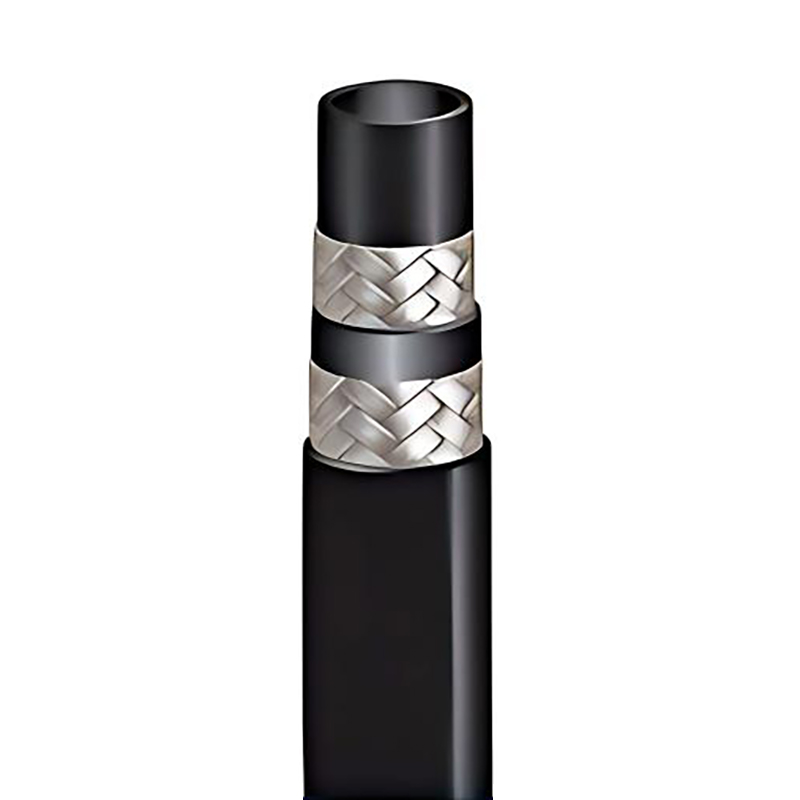
Drilling-Mud-Resistant Inner Tube
The inner tube remains in direct contact with drilling fluid. Liner selection depends on mud type, chemical additives, solids content and operating temperature.
A compatible liner helps maintain the physical properties required during pressure cycling, fluid exposure and hose movement.
High-Tensile Reinforcement
Multiple layers of high-strength steel wire or steel cable provide pressure containment while retaining the flexibility required between the mud pump and standpipe system.
The reinforcement structure depends on hose ID, working pressure, FSL, temperature and pulsation conditions.
Heavy-Duty Outer Cover
The outer cover protects the hose from drilling mud, oil contamination, UV, ozone, weather, rig steelwork and repeated handling.
Additional abrasion protection can be specified where the hose passes close to structural steel or other equipment.
High-Pressure Couplings
The hose body, coupling and end connection operate as one pressure-containing assembly.
Pressure rating, mating equipment, connection size, orientation and installation layout should therefore be evaluated together.
API 7K Vibrator Hose End Connections
API 7K Vibrator Hose assemblies can be supplied with Fig. 1002 Hammer Unions, Fig. 1502 Hammer Unions, flanged ends, hub ends or mixed End A / End B connections, depending on the rig interface.
For Hammer Union assemblies, specify the figure number, nominal size, working pressure and male/female orientation at each end.
A Fig. 1002 Vibrator Hose is commonly specified in high-pressure drilling mud systems, while selected interfaces use Fig. 1502 Mud Pump Hose connections.
For flanged assemblies, provide flange size, pressure rating, applicable specification and facing or ring-groove requirement. Hub-end projects should include the mating hub profile or equipment drawing.
| End Connection | Typical Application | RFQ Data Required |
| Fig. 1002 Hammer Union | High-pressure drilling mud system | Size, WP, M/F orientation |
| Fig. 1502 Hammer Union | High-pressure oilfield interface | Size, WP, M/F orientation |
| Flanged End | Mud pump / manifold / rigid piping | Size, rating, facing / groove |
| Hub End | Drilling package interface | Hub profile + mating equipment |
| Mixed Ends | Custom or replacement layout | Complete End A + End B details |
Where Is an API 7K Vibrator Hose Used?
| Application | Hose Role | Main Selection Factors |
| Mud Pump Discharge System | Flexible connection after mud pump | Pressure, FSL, vibration |
| Mud Pump to Standpipe Manifold | Primary vibrator hose position | Length, MBR, connections |
| Land Drilling Rig | High-pressure mud circulation | Pressure, temperature, routing |
| Pad / Skidding Rig | Repeated rig movement | Handling and connection consistency |
| Platform / Jack-Up Rig | Offshore mud circulation | Routing, abrasion protection and support |
| Semi-Submersible / Drillship | High-capacity offshore mud system | Flow, pressure, inspection and documentation |
| Directional / ERD | Demanding drilling hydraulics | Pulsation, flow and mud density |
| Deep-Well Drilling | Higher circulation pressure | Grade, FSL and temperature |
| Workover Unit | Flexible circulation connection | Fluid, pressure and layout |
| Mud Pump / Standpipe Upgrade | New operating conditions | WP, bore, length and connections |
| Rig Reactivation / Refurbishment | Replacement or redesign | Existing hose and layout verification |
| Spare Hose Program | Critical rig inventory | Compatibility and traceability |
The mud pump discharge system remains the primary application for an API 7K Vibrator Hose. Depending on company terminology, the same requirement may also be described as a Mud Pump Discharge Hose, Mud Pump Flexible Hose, Mud Pump Connector Hose, High Pressure Mud Pump Hose or Mud Pump to Standpipe Hose.
Land-rig projects typically focus on pressure, flow, routing and ambient conditions. Offshore applications place additional emphasis on abrasion protection, support, lifting arrangements, inspection and documentation.
For deep, directional or extended-reach drilling, pump output, circulation pressure, mud density, flow and pulsation should be evaluated together rather than using well depth alone to select the hose.
API 7K Vibrator Hose vs API 7K Rotary Hose
| Item | API 7K Vibrator Hose | API 7K Rotary Hose |
| Main Function | Carries mud and isolates mud pump vibration | Carries mud to moving Top Drive / swivel |
| Typical Position | Mud pump / manifold to standpipe | Standpipe to Top Drive / swivel |
| Main Movement | Vibration and limited movement | Repeated flexing and vertical travel |
| Typical Length | Usually shorter | Usually longer |
| Key Selection Issue | Pulsation, MBR and connection layout | Traveling movement, hose length and MBR |
| Main Fluid | High-pressure drilling mud | High-pressure drilling mud |
| FSL | FSL 1 / FSL 2 | FSL 1 / FSL 2 |
The oilfield market sometimes groups these products under Rotary and Vibrator Hose or Rotary Vibrator Hose, but their installation positions differ.
The Vibrator Hose works close to the mud pump and primarily accommodates pump vibration and pressure pulsation. The Rotary Hose connects the standpipe with the Top Drive or swivel and follows the traveling equipment.
The term Kelly Hose is generally associated with the rotary-hose side of the drilling mud system rather than the pump-side vibrator hose.
If the hose connects the standpipe to a Top Drive or swivel, an API 7K Rotary Hose is the appropriate product.
Minimum Bend Radius & Hose Length
Minimum Bend Radius, or MBR, directly affects hose routing and service life.
Operating below the specified MBR increases stress in the reinforcement, hose body and coupling transition areas.
A suitable layout considers connection distance, elevation difference, overall hose length, pressure-induced movement, mud pump vibration, assembly weight, support points and nearby rig structures.
Length also needs a clear definition. A specification such as 3-1/2 in. × 10 ft × 5000 PSI Vibrator Hose does not indicate whether 10 ft refers to overall assembly length, face-to-face length, end-to-end length or flexible-body length.
For compact rig packages and replacement projects, a dimensioned drawing provides the best basis for selection.
Custom API 7K Vibrator Hose Assemblies
Custom API 7K Vibrator Hose assemblies are available for Grade D 5000 psi, Grade E 7500 psi and selected higher-pressure project requirements.
Options include FSL 1 or FSL 2, approximately 2–6 in. hose IDs, custom overall lengths, Fig. 1002 or Fig. 1502 Hammer Unions, flanged ends, hub ends and mixed connections.
Hose construction can also be selected for compatible water-based mud, oil-based mud, abrasive drilling fluids and higher-temperature service.
Typical projects include new drilling rigs, mud pump upgrades, offshore drilling packages, rig refurbishment, rig reactivation and critical spare-hose programs.
Replacement API 7K Vibrator Hose
For a Replacement API 7K Vibrator Hose, the existing assembly is usually the most useful starting point.
The hose nameplate, layline marking, hose ID, working pressure, Grade, FSL, temperature designation, overall length and End A / End B details provide the core replacement data.
Clear photographs of both connections and the installed hose help confirm mating equipment and available routing space.
Do not identify a replacement hose only by outside diameter. Similar OD does not guarantee the same bore, reinforcement structure, working pressure, minimum bend radius or FSL.
Where the original datasheet is unavailable, SGPE can use existing markings, dimensions and photographs to establish the replacement specification.
How to Select and Order an API 7K Vibrator Hose
Start with the installation position and confirm that the rig requires a Vibrator Hose rather than a Rotary Hose, Jumper Hose or Cement Hose.
Next, identify hose ID, rated working pressure, Grade and FSL. The RFQ should also state the drilling fluid and both minimum and maximum operating temperatures.
Overall length needs a clear definition, especially where installation space is limited. End A and End B should be specified separately with connection type, nominal size, pressure rating and male/female orientation.
Finally, identify any safety-restraint, external-protection, TPI, documentation and delivery requirements.
A complete hose specification can be summarized as:
Hose ID + Working Pressure + Grade + FSL + Temperature + Fluid + Overall Length + End A + End B + Quantity
API 7K Vibrator Hose RFQ Checklist
| RFQ Item | Example / Information Required |
| Product | API 7K Vibrator Hose |
| Application | Mud pump manifold to standpipe manifold |
| Rig Type | Land / Platform / Jack-Up / Semi / Drillship |
| Hose ID | 3-1/2 in. |
| Working Pressure | 7,500 psi |
| Grade | Grade E |
| FSL | FSL 2 |
| Minimum / Maximum Temperature | Specify |
| Overall Length | e.g. 10 ft |
| Length Definition | Overall / Face-to-Face |
| MBR / Available Space | Confirm |
| End A | e.g. Fig. 1002 Male |
| End B | e.g. Fig. 1002 Female |
| Drilling Fluid | Water-Based / Oil-Based Mud |
| Mud Density / Abrasive Solids | Provide where relevant |
| Sour / H2S Requirement | Specify if applicable |
| Safety Restraint | Required / Not Required |
| External Protection | Required / Not Required |
| Quantity | EA |
| TPI | Required / Not Required |
| Required Documents | Specify |
| Delivery Country / Port | Specify |
For replacement hoses, include the existing hose nameplate, layline marking, connection photographs, dimensions and installation photographs whenever available.
What Determines API 7K Vibrator Hose Price?
The API 7K Vibrator Hose price depends on the complete assembly rather than only its length or a price per meter.
| Price Factor | Why It Matters |
| Hose ID | Larger bore requires more material and reinforcement |
| Working Pressure | Higher pressure requires heavier construction |
| Grade / FSL | Affect hose construction and qualification requirements |
| Overall Length | Affects hose body and reinforcement quantity |
| End Connections | Hammer Union, flange, hub and mixed ends have different costs |
| Temperature / Mud Type | Affect liner and material selection |
| Safety Accessories | Restraint and lifting accessories add project scope |
| TPI | Independent inspection adds project requirements |
| Documentation | Special MDR or inspection dossiers add scope |
| Quantity | Affects manufacturing and packing efficiency |
For an accurate API 7K Vibrator Hose price or quotation, provide the complete technical requirement rather than requesting only a unit price.
For example:
3-1/2 in. Grade E FSL 2 Vibrator Hose, 7,500 psi, 10 ft, Fig. 1002 Male × Female, oil-based mud service
provides enough information for a meaningful technical and commercial review.
SGPE Quality Control, Testing & Documentation
SGPE treats the API 7K Vibrator Hose as a complete high-pressure assembly rather than only as a flexible hose body.
Inspection can verify the approved hose construction, dimensions, end fittings, connection orientation and specified accessories.
End connections require particular attention because an incorrect Hammer Union, flange or hub can prevent field installation even when the hose itself has the correct pressure rating.
Completed assemblies undergo hydrostatic testing according to approved technical and project requirements. Final inspection can also cover the hose body, outer cover, couplings, product marking and specified safety accessories.
Where the purchase order requires independent inspection, the agreed TPI scope can be coordinated as part of the order.
Depending on project requirements, documentation can include pressure-test reports, dimensional inspection records, identification and traceability records, packing documents and a project-specific quality dossier.
Why Choose SGPE as Your API 7K Vibrator Hose Supplier?
Oilfield-Focused Technical Support
SGPE focuses on oil and gas drilling, pressure-control and high-pressure oilfield equipment. The vibrator hose is therefore evaluated as part of the complete drilling mud circulation system rather than as a general-purpose industrial hose.
Custom & Replacement Hose Support
Different rigs use different mud pump and standpipe layouts. Custom lengths, Hammer Union connections, flanges, hubs and mixed End A / End B configurations can be supplied according to project requirements.
Where the original replacement datasheet is unavailable, existing hose markings, dimensions and photographs provide a practical basis for technical matching.
New Rig, Upgrade & Retrofit Projects
SGPE supplies vibrator hoses for new drilling rig packages, mud pump upgrades, standpipe manifold modifications, rig refurbishment and rig reactivation projects.
Testing & Project Documentation
Orders can include agreed hydrostatic testing, dimensional inspection, third-party inspection coordination and documentation according to the purchase-order scope.
International Oilfield Supply
SGPE works with drilling contractors, rig owners, oilfield service companies, operators, EPC contractors, drilling equipment manufacturers and distributors serving international oil and gas projects.
Related Drilling Hose Products
| Related Product | Typical Position / Application |
| API 7K Rotary Hose | Standpipe to Top Drive or swivel |
| API 7K Jumper Hose | Flexible high-pressure connection between suitable fixed system components |
| High Pressure Drilling Hose | Broader drilling-fluid hose category |
Frequently Asked Questions About API 7K Vibrator Hoses
1. What is an API 7K Vibrator Hose and what does it do on a drilling rig?
An API 7K Vibrator Hose is a flexible high-pressure drilling mud hose that normally connects the mud pump discharge system with the standpipe manifold. Buyers may also refer to it as a Drilling Vibrator Hose, Mud Vibrator Hose, High Pressure Mud Hose, Mud Pump Vibrator Hose or Mud Pump Discharge Hose.
The hose transfers drilling fluid while accommodating mud pump vibration, repeated pressure pulsation and limited movement between connected equipment. This flexible connection reduces the direct transfer of dynamic loads into rigid piping, valves and manifold components. Drilling contractors commonly use API 7K Vibrator Hoses on land rigs, offshore platforms, jack-up rigs, drillships and other high-pressure drilling mud circulation systems.
2. Where does an API 7K Vibrator Hose connect in the drilling mud circulation system?
An API 7K Vibrator Hose normally connects the mud pump discharge or pump manifold with the standpipe manifold.
A typical drilling fluid path runs as follows: Mud Pump → Vibrator Hose → Standpipe Manifold → Standpipe → Rotary Hose → Top Drive or Swivel → Drill String. This installation position also explains common purchasing terms such as Mud Pump to Standpipe Hose, Mud Pump Connector Hose, Standpipe Manifold Hose and High Pressure Mud Pump Hose.
Rig layouts vary, so buyers should check the mud pump outlet, manifold arrangement, hose routing and available installation space before placing an order.
3. Is an API 7K Vibrator Hose the same as an API 7K Rotary Hose or Kelly Hose?
No. An API 7K Vibrator Hose and an API 7K Rotary Hose both carry high-pressure drilling mud, but they serve different sections of the circulation system.
The Vibrator Hose works close to the mud pump and mainly absorbs pump vibration and pressure pulsation. The Rotary Hose connects the standpipe with the Top Drive or swivel and follows the repeated movement of the traveling equipment. The industry generally uses Kelly Hose for the rotary-hose side of the drilling system.
Do not interchange the two hoses simply because they share a similar hose ID, working pressure or connection type. The installation position, movement, minimum bend radius and required hose length must also suit the application.
4. What working pressures and grades do buyers commonly specify for API 7K Vibrator Hose?
Buyers commonly specify Grade D 5000 PSI Vibrator Hose and Grade E 7500 PSI Vibrator Hose for drilling mud circulation systems.
Grade D suits many conventional high-pressure mud pump discharge applications, while Grade E serves higher-pressure drilling mud systems. Some projects also specify 10,000 psi or 15,000 psi requirements, but SGPE reviews these higher-pressure configurations according to the actual project conditions.
Working pressure alone cannot define the correct hose. Buyers should also consider hose ID, FSL, drilling fluid, operating temperature, overall length, minimum bend radius, end connections and rig layout.
5. What is the difference between FSL 1 and FSL 2 API 7K Vibrator Hose?
FSL means Flexible Specification Level and plays an important role in API 7K hose selection.
FSL 1 covers rotary, vibrator and jumper hose applications under normal service conditions. An FSL 2 Vibrator Hose addresses more demanding pressure-pulsation conditions, including applications where high-frequency pulsation amplitudes can exceed approximately 1,000 psi / 6.9 MPa.
Buyers should base the FSL selection on the actual mud pump and circulation-system pulsation rather than only on well depth, offshore location or rig type. Deep wells, directional drilling, ERD and offshore operations can create demanding hydraulic conditions, but these factors alone do not automatically require FSL 2.
6. What API 7K Vibrator Hose sizes do mud pump systems commonly use?
API 7K Vibrator Hose sizes generally range from approximately 2 in. to 6 in. ID, depending on hose construction and operating conditions.
Mud pump and standpipe systems commonly use 3 in., 3-1/2 in. and 4 in. Vibrator Hoses. Typical inquiries include a 3 Inch 5000 PSI Vibrator Hose, 3-1/2 Inch Grade D Mud Hose, 3-1/2 Inch Grade E 7500 PSI Vibrator Hose or 4 Inch Mud Pump Discharge Hose.
The correct bore depends on mud pump output, required flow rate, drilling-fluid properties, working pressure, manifold connections and available routing space. Buyers should also confirm the end-connection size separately because it does not always match the hose ID.
7. What temperature range can an API 7K Vibrator Hose handle?
The operating temperature of an API 7K Vibrator Hose depends on the inner tube material and the complete hose construction.
As an industry reference, selected NBR-lined constructions can operate from approximately -25°C to +100°C, while selected HNBR constructions can extend to approximately +121°C. These values provide a selection reference rather than a universal limit for every hose assembly.
Temperature becomes especially important in desert drilling, cold-region operations, offshore drilling and high-temperature mud circulation. Buyers should provide both the minimum service temperature and the maximum drilling-fluid temperature so SGPE can match the liner and hose construction to the actual operating environment.
8. Can an API 7K Vibrator Hose handle both water-based and oil-based drilling mud?
Yes. SGPE can select compatible API 7K Vibrator Hose constructions for both water-based and oil-based drilling fluids.
A Water-Based Mud Vibrator Hose must suit the actual additives, solids content and operating temperature. For an Oil-Based Mud Vibrator Hose, the liner must remain compatible with the fluid composition and temperature.
High-density or abrasive drilling mud can increase internal wear, especially at higher circulation velocities. Buyers should provide mud density, solids content, flow rate and temperature during the RFQ stage. If the project involves unusual chemical additives or H2S exposure, include those conditions before final material selection.
9. Can SGPE supply API 7K Vibrator Hose with Fig. 1002 or Fig. 1502 Hammer Union ends?
Yes. SGPE supplies API 7K Vibrator Hose assemblies with Fig. 1002 or Fig. 1502 Hammer Union connections, as well as flanged, hub and mixed End A / End B configurations.
For a Fig. 1002 Vibrator Hose or Fig. 1502 Mud Pump Hose, buyers should state the nominal connection size, working pressure and male or female orientation at each end. End A and End B do not always use the same configuration.
For flange or hub connections, provide the applicable size, pressure rating, facing or ring-groove details and mating-equipment information. Connection photographs or drawings help SGPE confirm the interface more accurately, especially for replacement and rig-refurbishment projects.
10. How do I select the correct API 7K Vibrator Hose length and minimum bend radius?
The correct API 7K Vibrator Hose length depends on the distance between connection points, elevation difference, hose routing, minimum bend radius, assembly weight, pressure-induced movement and available rig clearance.
Keep the hose above its specified Minimum Bend Radius (MBR) during operation because excessive bending increases stress in the reinforcement and coupling transition areas.
Buyers should also define the hose length clearly. For example, 3-1/2 in. × 10 ft × 5000 PSI Vibrator Hose does not indicate whether 10 ft means overall assembly length, face-to-face length, end-to-end length or flexible-body length. For compact rigs, offshore packages and replacement projects, a dimensioned drawing gives the clearest basis for hose selection.
11. How do I order a replacement API 7K Vibrator Hose for an existing drilling rig?
For a Replacement API 7K Vibrator Hose, start with the existing hose when the original technical datasheet is unavailable.
Provide the hose nameplate, layline marking, hose ID, rated working pressure, Grade, FSL, temperature designation, overall length and End A / End B connection details. Clear photographs of the Hammer Union, flange or hub connections and the installed hose routing can also help SGPE identify the correct replacement configuration.
Do not rely on outside diameter alone. Two hoses with a similar OD can still differ in bore, reinforcement structure, pressure rating, MBR and FSL. SGPE can use the available markings, dimensions and installation information to establish the correct replacement specification.
12. What information should I send SGPE for an API 7K Vibrator Hose quotation?
For a fast and accurate API 7K Vibrator Hose quotation, provide the hose ID, working pressure, Grade, FSL, overall length, operating temperature, drilling fluid, End A connection, End B connection and required quantity.
Also tell SGPE whether the hose will work on a land rig, offshore platform, jack-up rig, drillship, workover unit, mud pump upgrade or replacement project. Include any requirements for safety restraints, external abrasion protection, third-party inspection, documentation and delivery destination.
For replacement hoses, send the existing datasheet, nameplate, layline marking, connection photographs or rig-layout drawing whenever available. SGPE will review the operating conditions and recommend a suitable API 7K Vibrator Hose configuration with a corresponding quotation.
Request API 7K Vibrator Hose Price & Quotation
Looking for an API 7K Vibrator Hose for a new drilling rig, mud pump upgrade, standpipe modification or replacement project?
SGPE supplies Grade D 5000 PSI and Grade E 7500 PSI Vibrator Hoses, with FSL 1 or FSL 2, custom lengths, and Fig. 1002, Fig. 1502, flanged, hub or mixed end connections for land and offshore drilling applications.
For an accurate quotation, please provide:
Hose ID + Working Pressure + Grade + FSL + Overall Length + Temperature + Drilling Fluid + End A + End B + Quantity
For replacement hoses, you can also send the existing datasheet, nameplate, layline marking, connection photographs or rig layout.
Email: info@sgpe.com
Tel / WhatsApp: +86 186-1599-5239