
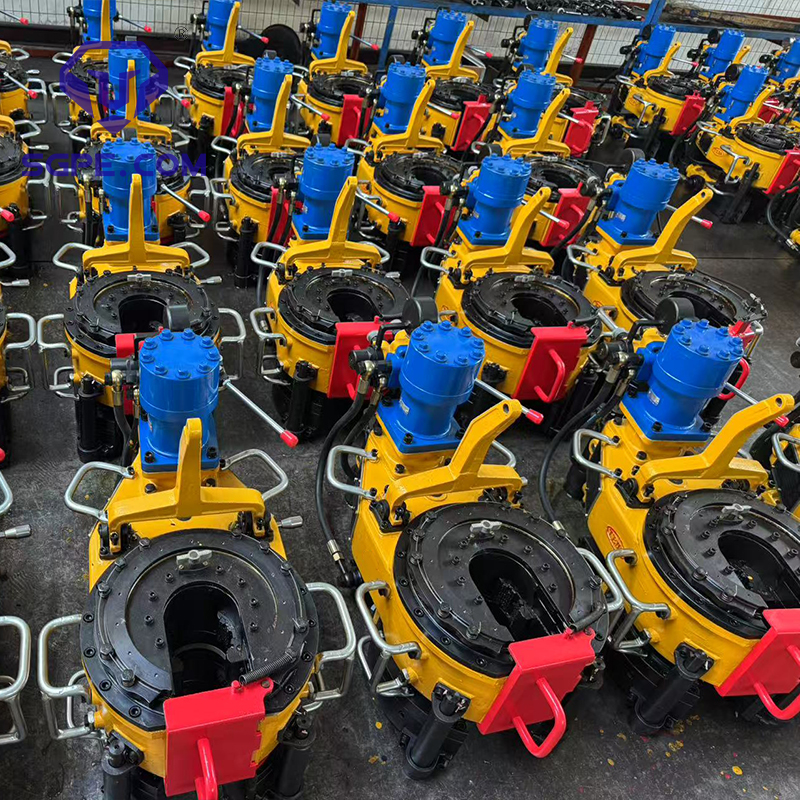
Description
Hydraulic Backup Tong for Drilling, Workover & Well Service Power Tongs
SGPE Hydraulic Backup Tong provides secure tubular gripping and controlled torque reaction during oilfield make-up and breakout. It works with a hydraulic power tong to hold one side of a threaded connection while the main tong rotates the other side.
Together, the power tong and backup tong form a stable connection-handling system for tubing, casing and drill pipe. The backup unit keeps the opposite tubular from turning, creates a reaction point close to the connection and supports repeatable make-up and breakout work on drilling rigs, workover rigs and well-service units.
SGPE can match backup tong configurations to tubing power tongs, casing power tongs, drill pipe power tongs, XQ workover tongs, TQ casing tongs, ZQ drill pipe tongs and equivalent oilfield power tong systems.
Depending on the application, the backup unit may grip the pipe body, tubing coupling, casing coupling or drill pipe tool joint. Available options can include interchangeable jaws, tong dies, hydraulic cylinders, standard or extended guide rods, hydraulic hoses, control valves, torque sensors, load cells and torque-monitoring equipment.
We support new installations as well as replacement Hydraulic Backup Tong projects for existing power tongs.
Need a backup tong for an existing tong? Send the power tong model, actual gripping OD, coupling or tool joint OD, required torque, hydraulic pressure, hydraulic flow and equipment photos for technical review.
Email: info@sgpe.com
Tel / WhatsApp: +86 186-1599-5239
What Is a Hydraulic Backup Tong?
A Hydraulic Backup Tong, also known as a power tong backup tong or oilfield backup tong, provides the controlled reaction required during tubular make-up and breakout.
The main power tong applies rotational torque to one side of the threaded connection. At the same time, the backup tong grips the opposite side and prevents it from rotating with the main tong.
In practical terms:
Power Tong = applies rotational torque
Hydraulic Backup Tong = holds the opposite side and resists that torque
The backup unit may grip a pipe body, coupling or tool joint.
That difference matters. A tubing coupling, casing coupling or drill pipe tool joint often has a larger outside diameter than the pipe body. As a result, the actual gripping OD is usually more useful than nominal pipe size when choosing a new backup tong or replacing an existing unit.
This becomes especially important on older XQ, TQ and ZQ power tong systems, where mounting arrangements, guide rods and backup jaw ranges can vary between models.
Which Hydraulic Backup Tong Do You Need?
| Application | Recommended Backup Type | Typical Gripping Point | Key Selection Data |
|---|---|---|---|
| Tubing running | Hydraulic Tubing Backup Tong | Tubing body / coupling | Tubing OD, coupling OD |
| Workover / well servicing | Workover Backup Tong | Tubing / small casing | Breakout torque, rig layout |
| Casing running | Hydraulic Casing Backup Tong | Casing body / coupling | Casing OD, coupling OD, torque |
| Higher-torque casing | Heavy-Duty Casing Backup Tong | Casing coupling | Reaction capacity, hydraulics |
| Drill pipe make-up / breakout | Drill Pipe Backup Tong | Tool joint / drill pipe | Tool joint OD, torque |
| Existing tong refurbishment | Replacement Backup Tong | Existing gripping point | Mounting, guide rods, hydraulics |
| Special tubular application | Custom Backup Tong | Project-specific | Drawing, OD, torque, interface |
This table provides a quick starting point. Final selection still depends on the main power tong, actual gripping diameter, hydraulic system and connection torque.
Why Use a Hydraulic Backup Tong?
Stable Torque Reaction
The backup tong creates a fixed reaction point close to the threaded connection while the main power tong applies make-up or breakout torque.
This keeps the opposite tubular stable and reduces unwanted rotation through the lower string.
Secure Tubular Gripping
Correct jaws and tong dies provide firm contact with the pipe body, coupling or tool joint.
Reliable gripping matters during repeated workover cycles, higher-torque casing jobs and breakout work on connections that have remained in service for long periods.
Faster Connection Handling
Hydraulic clamping lets crews grip and release tubulars quickly. A hydraulic power tong backup therefore suits repetitive tubing running, casing running, pulling and well-servicing operations.
Flexible Gripping Range
Interchangeable jaws and dies can allow one backup configuration to cover several gripping diameters within its designed range.
Torque Monitoring Options
Selected systems can use a torque sensor, load cell, digital torque display or torque-turn monitoring system to support connection control, make-up documentation and job records.
Hydraulic Backup Tong Technical Specifications
A backup tong should match the complete power tong system rather than nominal pipe size alone.
| Parameter | Typical / Configurable Specification |
|---|---|
| Product | Hydraulic Backup Tong |
| Application | Oil & gas drilling, workover and well servicing |
| Main Function | Tubular gripping and torque reaction |
| Operation | Make-up and breakout |
| Compatible Tubulars | Tubing, casing and drill pipe |
| Compatible Power Tongs | Tubing, casing and drill pipe power tongs |
| Common System Families | XQ / TQ / ZQ and equivalent systems |
| Control | Hydraulic |
| Actuation | Hydraulic cylinder |
| Gripping Mechanism | Jaw, cam or roller type depending on design |
| Gripping Position | Pipe body, coupling or tool joint |
| Jaw System | Replaceable / interchangeable |
| Tong Dies | Replaceable gripping inserts |
| Typical XQ Backup Range | Approx. 60–156 mm on common configurations |
| Casing Backup Range | Selected according to casing / coupling OD |
| Reaction Torque | Matched to main tong and backup design |
| Hydraulic Pressure | Matched to power tong / HPU |
| Hydraulic Flow | Matched to hydraulic circuit |
| Hydraulic Ports | Matched to existing system |
| Torque Sensor | Optional |
| Load Cell | Optional |
| Torque Display / Recording | Optional |
| Torque-Turn Monitoring | Optional |
| Standard Guide Rod | Available |
| Extended Guide Rod | Optional |
| Mounting Arrangement | Matched to main power tong |
| Replacement Cylinder | Available after dimensional confirmation |
| Spare Jaws / Dies | Available according to model and gripping OD |
| Working Environment | Land rig, offshore rig, workover rig, well-service unit |
Reference note: These specifications describe typical oilfield configurations rather than one universal SGPE model. Final parameters depend on the selected tong, actual gripping diameter, hydraulic system and operating requirements.
Hydraulic Tubing Backup Tong for XQ Power Tongs
A Hydraulic Tubing Backup Tong works with a tubing power tong during production tubing running, tubing pulling, workover and well servicing.
Tubing jobs often involve many repeated threaded connections. Hydraulic gripping lets the crew secure the opposite side quickly while the main tong completes make-up or breakout.
Typical applications include production tubing running, tubing pulling, tubing replacement, pump-change work, completion tubing installation and well intervention.
Because a tubing coupling normally has a larger OD than the tubing body, the three most useful dimensions are:
Tubing OD + Coupling OD + Actual Gripping Position
These values help determine the correct jaw range and whether the backup unit should grip the coupling or the tubing body.
Typical XQ Hydraulic Backup Tong Reference
XQ tubing power tong systems commonly use an integrated hydraulic backup tong. The backup range may be larger than the main tong range because the backup unit often grips the tubing coupling.
| Typical XQ Configuration | Main Tong Range | Backup Tong Range | System Torque | Rated Pressure | Max. Oil Supply |
|---|---|---|---|---|---|
| XQ89/3 type | 60–89 mm | 60–114 mm | Approx. 3.3 kN·m | 10 MPa | 80 L/min |
| XQ114/6 type | 60–114 mm | Approx. 73–141.5 mm | Approx. 6 kN·m | 11 MPa | 100 L/min |
| XQ140/12 type | Up to 140 mm | Up to approx. 156 mm | Approx. 12 kN·m | 12 MPa | 120 L/min |
| XQ140/20 class | Up to 140 mm | Up to approx. 154–156 mm | Approx. 20 kN·m | Approx. 17.5 MPa | Approx. 140 L/min |
These figures are industry reference data for preliminary matching only. Exact specifications vary by manufacturer and model.
For a replacement XQ Hydraulic Backup Tong, XQ114 power tong backup or XQ140 backup tong, the most useful information is the exact tong model, tubing OD, coupling OD, jaw range, guide rod dimensions and hydraulic data.
If the backup tong needs to grip the tubing body rather than the coupling, an extended guide rod may provide the extra vertical distance required.
Hydraulic Casing Backup Tong for TQ Power Tongs
A Hydraulic Casing Backup Tong provides reaction torque during casing make-up, breakout, pulling and recovery.
Casing operations usually involve larger gripping diameters and higher connection torque than standard tubing work. The backup unit may therefore require a stronger frame, larger jaw opening, larger tong dies and a heavier mounting arrangement.
Typical applications include surface casing, intermediate casing and production casing running. The same system can also support casing pulling, casing recovery and selected workover jobs.
For casing projects, the most useful starting information is:
Casing OD + Coupling OD + Make-Up Torque + Expected Breakout Torque
The coupling OD often determines the actual backup tong gripping range.
Typical TQ Casing Power Tong Reference
| Typical System Class | Main Tong Range | Typical Pressure | Typical Oil Flow | Typical System Torque |
|---|---|---|---|---|
| TQ178 Class | Approx. 101.6–178 mm | Approx. 16–18 MPa | Approx. 110–160 L/min | Approx. 16–19 kN·m |
| TQ340 Class | Approx. 114.3–340 mm | Approx. 18–20 MPa | Approx. 110–170 L/min | Approx. 32–40+ kN·m |
These values describe typical complete power tong system classes and serve only as preliminary matching references.
For a replacement backup tong for TQ casing power tong, provide the exact tong model, casing OD, coupling OD, required torque and hydraulic-system data.
Heavy-Duty Casing Backup Tong
Large casing connections can require significantly higher reaction capacity than tubing connections.
A heavy-duty casing backup may use a reinforced frame, larger hydraulic cylinder, heavy-duty jaw carriers, larger tong dies and stronger guide components.
Final selection should follow the actual casing connection dimensions, required reaction capacity, hydraulic supply and mounting arrangement.
Drill Pipe Backup Tong for ZQ Power Tongs
A Drill Pipe Backup Tong works with a drill pipe power tong during drill string make-up and breakout.
In many applications, the backup unit grips the tool joint rather than the drill pipe body. Nominal drill pipe OD alone therefore does not provide enough information for correct matching.
Typical jobs include drill pipe make-up, drill pipe breakout, tool joint gripping, drill string assembly and selected workover operations.
For correct selection, confirm:
Drill Pipe OD + Tool Joint OD + Power Tong Model + Required Torque
Typical ZQ Drill Pipe Power Tong Reference
| ZQ System Class | Typical Main Tong Range | Typical System Pressure | Typical Oil Flow | Typical Torque Class |
|---|---|---|---|---|
| ZQ127 Class | Approx. 65–127 mm | Approx. 12–16 MPa | Approx. 120 L/min | Approx. 25 kN·m |
| ZQ162 Class | Approx. 85–162 mm | Approx. 14 MPa | Approx. 120 L/min | Approx. 50 kN·m |
| ZQ203 Class | Approx. 127–203 mm | Approx. 16.6–20.7 MPa | Approx. 114 L/min | Approx. 100–125 kN·m |
These figures describe typical complete ZQ power tong systems. They do not mean that every backup tong carries the full maximum torque of the main tong.
For a ZQ Drill Pipe Tong Backup, tool joint OD, guide arrangement and existing backup geometry are the main mechanical matching dimensions.
Hydraulic Backup Tong for Workover Rigs
A Hydraulic Backup Tong for Workover Rig normally works with a tubing power tong on workover rigs and mobile well-service units.
Typical jobs include pulling production tubing, running replacement tubing, changing pumps, repairing tubing and breaking out connections that have remained downhole for long periods.
Older connections can require higher breakout force. Crews should therefore check the tong dies, jaw condition, hydraulic cylinder and gripping range before beginning the job.
For older workover tongs, a nameplate photo, backup tong dimensions and guide rod arrangement are especially useful when identifying a replacement unit.
Pipe Body, Coupling or Tool Joint Gripping
The intended gripping point affects the jaw set, tong dies and backup tong position.
| Gripping Position | Typical Application | Main Data Required | Typical Configuration |
|---|---|---|---|
| Tubing Body | Workover / tubing | Tubing OD | Extended guide rod may help |
| Tubing Coupling | Tubing make-up / breakout | Coupling OD | Standard backup position |
| Casing Body | Special casing work | Casing OD | Larger jaw / die set |
| Casing Coupling | Casing running | Coupling OD | Heavy-duty backup |
| Drill Pipe Body | Selected workover jobs | Pipe OD | Application-specific |
| Tool Joint | Drill pipe make-up / breakout | Tool Joint OD | Drill pipe backup jaws |
A backup tong that fits a coupling may not correctly grip the corresponding pipe body.
For this reason, SGPE normally asks for the actual gripping OD, rather than nominal pipe size alone.
Main Hydraulic Backup Tong Components
| Component | Main Function | Key Matching Point |
|---|---|---|
| Tong Body / Frame | Carries reaction load | Mounting geometry |
| Jaw Assembly | Transfers clamping force | Jaw opening and gripping OD |
| Tong Dies / Inserts | Grip tubular | Size and tooth profile |
| Hydraulic Cylinder | Drives clamp / release | Bore, stroke and pressure |
| Guide Rod | Positions backup tong | Diameter and spacing |
| Roller / Cam | Transfers jaw movement | Size and wear |
| Pin / Bushing | Supports moving joints | Diameter and clearance |
| Hydraulic Hose | Transfers hydraulic oil | Pressure and fitting |
| Control Valve | Controls gripping | Port / circuit |
| Torque Sensor | Measures reaction force | Capacity and output |
| Mounting Bracket | Connects backup unit | Interface dimensions |
Small differences in jaw opening, cylinder stroke, guide rod spacing or mounting geometry can affect installation.
Hydraulic Backup Tong Jaws and Dies
The backup tong jaw system transfers hydraulic clamping force into the tubular.
Depending on the design, the tong may use curved jaws, cam-operated jaws, roller-climbing jaws, interchangeable jaw carriers or replaceable tong dies.
Replacement gripping components can include backup tong jaws, tubing tong dies, casing tong dies, drill pipe tong dies, tool joint dies, jaw inserts, die carriers and complete jaw assemblies.
Worn dies can reduce gripping force and increase slippage. Incorrect die dimensions or tooth geometry can also increase local surface marking.
For replacement backup tong jaws and dies, the most useful information is:
Tong Model + Actual Gripping OD + Jaw Dimensions + Die Dimensions + Part Photos
If the tong body and hydraulic system remain serviceable, replacing the jaw assembly or tong dies may restore the required gripping range without replacing the complete backup unit.
Hydraulic Backup Tong Cylinder and Seal Kit
The Hydraulic Backup Tong Cylinder drives the jaw mechanism.
| Cylinder Parameter | Why It Matters |
|---|---|
| Bore Diameter | Determines hydraulic force |
| Rod Diameter | Affects rod strength |
| Stroke | Determines jaw travel |
| Working Pressure | Must match hydraulic circuit |
| Closed Length | Affects installation |
| Extended Length | Controls movement range |
| Mounting Type | Must fit tong frame |
| Pin Diameter | Controls mechanical fit |
| Port Type / Size | Must match hydraulic system |
| Port Orientation | Affects hose routing |
| Seal Arrangement | Required for repair kits |
Do not select a replacement backup tong hydraulic cylinder by appearance alone. A small difference in stroke, pin center or port location can prevent correct installation.
For a Hydraulic Backup Tong Cylinder Seal Kit, provide the cylinder model when available, together with bore diameter, rod diameter, working pressure and seal dimensions.
Standard and Extended Guide Rod Options
Guide rods keep the backup unit aligned below the main power tong.
A standard arrangement works well when the backup tong grips a coupling close to the main tong. Some jobs, however, require the backup unit to sit farther below the connection so it can grip the tubing body.
An Extended Guide Rod Hydraulic Backup Tong or lengthened guide pole arrangement can provide this additional vertical distance.
For replacement or custom guide rods, the key dimensions are:
Rod Diameter + Center-to-Center Spacing + Required Working Length
Hydraulic Backup Tong Torque Sensor and Torque Monitoring
A Hydraulic Backup Tong Torque Sensor or load cell measures reaction force at the backup unit.
A compatible monitoring system converts this force into calculated connection torque according to the tong geometry.
Depending on the configuration, the system can support real-time torque display, maximum torque indication, make-up torque recording, connection documentation and torque-turn monitoring.
| Component | Function |
|---|---|
| Torque Sensor / Load Cell | Measures reaction force |
| Torque Display | Shows calculated torque |
| Data Recorder | Stores make-up data |
| Pressure Sensor | Monitors hydraulic parameters |
| Control Unit | Processes sensor signals |
| Torque-Turn Software | Records torque versus turns when required |
A Power Tong Torque Monitoring System should match the tong model, maximum torque, sensor mounting arrangement, display type and recording requirements.
Hydraulic Backup Tong for Premium Connections
Premium tubing and casing connections can require tighter make-up control and greater attention to tubular surface condition.
Important data include:
Pipe OD + Connection OD + Connection Type + Make-Up Torque + Maximum Torque + Gripping Position
If the connection manufacturer limits surface marking or specifies a particular tong die design, include that requirement during technical review.
Projects that require connection documentation can also use torque recording or torque-turn monitoring when the selected system supports these functions.
Always follow the connection manufacturer’s approved make-up procedure.
How Does a Hydraulic Backup Tong Work?
1. Position the Power Tong and Backup Tong
The crew positions both tongs around the threaded connection and checks the required gripping points.
2. Clamp the Opposite Tubular
Hydraulic pressure moves the backup cylinder and jaw mechanism until the tong securely grips the pipe body, coupling or tool joint.
3. Apply Make-Up or Breakout Torque
The main power tong rotates one side of the connection while the backup tong holds the opposite side and provides the required reaction.
4. Monitor and Release
When torque monitoring is available, the operator follows connection torque during make-up. Once the cycle is complete, the backup tong releases and the crew moves to the next connection.
Hydraulic System Matching
A backup tong normally shares the main power tong hydraulic source or connects to a compatible hydraulic power unit.
| Hydraulic Data | Why It Matters |
|---|---|
| Working Pressure | Confirms cylinder compatibility |
| Maximum Pressure | Helps prevent overpressure |
| Available Oil Flow | Affects operating speed |
| Pressure Port | Confirms hose interface |
| Return Port | Confirms circuit compatibility |
| Hose ID | Affects flow and pressure drop |
| Fitting Standard | Prevents connection mismatch |
| Hydraulic Oil | Checks seal compatibility |
| HPU Model | Helps match complete system |
| Hose Length | Important for rig-floor layout |
A backup tong can match the tubular diameter and still be unsuitable if the hydraulic pressure, oil flow, port configuration or hose arrangement does not match the existing system.
Reference note: XQ, TQ and ZQ values shown on this page are preliminary industry references. Final SGPE specifications should be confirmed on the approved technical datasheet before order.
Hydraulic Backup Tong Applications in Oil & Gas
Land Drilling Rigs
Hydraulic backup tongs can support casing running, drill pipe connection handling and selected tubing work on land rigs. They provide a stable reaction point during repeated rig-floor make-up and breakout cycles.
Workover Rigs and Well-Service Units
Workover and well-service crews use tubing power tong and backup tong combinations during tubing pulling, tubing replacement, pump changes, well maintenance and connection breakout.
Compact XQ-type systems suit jobs that involve repeated production tubing handling.
Casing Running Services
A Casing Power Tong Backup Tong supports surface, intermediate and production casing installation. Larger casing connections may require greater jaw opening, stronger mounting components and higher reaction capacity.
Well Completion and Intervention
Tubing backup tongs can support completion tubing installation, production tubing running and later intervention work.
When required, torque monitoring can also support jobs that need documented connection make-up data.
Offshore Platforms and Jack-Up Rigs
When the selected configuration matches the rig layout and project requirements, hydraulic backup tongs can support tubular operations on fixed offshore platforms, jack-up rigs and offshore workover units.
Oilfield Equipment Workshops
Service companies can use replacement backup tongs, cylinders, guide rods, jaws, dies and torque sensors to repair and maintain older power tong fleets.
Replacement Hydraulic Backup Tong for Existing Power Tongs
Replacing the complete power tong is not always necessary.
If the main tong remains mechanically and hydraulically serviceable, SGPE can match a Replacement Hydraulic Backup Tong to the existing equipment.
To ensure correct compatibility, the replacement unit should match the original power tong manufacturer and model, existing backup tong dimensions, actual gripping range, guide rod diameter and spacing, mounting interface, hydraulic pressure, oil flow, pressure and return port arrangement, jaw configuration and required reaction torque.
These details are especially important because even small differences in mounting geometry, guide rod spacing, hydraulic connections or jaw range can affect installation and operating performance.
A correctly matched replacement unit can support power tong refurbishment, backup tong retrofit, oilfield tong repair and older power tong modernization without requiring replacement of the complete tong system.
What If the Power Tong Model Is Unknown?
Older power tongs do not always retain their original nameplates, drawings or manuals.
In this situation, clear photographs of the complete power tong, tong head, backup unit, jaws, hydraulic cylinder, guide rods, mounting points, hydraulic hoses, ports and any visible casting or part numbers can help with identification.
Basic measurements such as the actual gripping range, guide rod diameter, guide rod spacing and key mounting dimensions are also useful. With this information, SGPE can review the existing configuration and determine whether a standard replacement backup tong, modified unit or custom matching solution is more suitable.
Hydraulic Backup Tong Spare Parts
SGPE can supply Hydraulic Backup Tong Spare Parts for repair and refurbishment.
| Spare Part | Main Function | Data Needed |
|---|---|---|
| Backup Tong Die | Grips tubular | OD, dimensions, tooth pattern |
| Jaw Assembly | Transfers clamping load | Tong model, opening range |
| Jaw Insert | Replaceable gripping surface | Dimensions |
| Die Carrier | Holds tong die | Drawing / measurements |
| Hydraulic Cylinder | Drives jaw system | Bore, rod, stroke, ports |
| Cylinder Seal Kit | Repairs cylinder | Cylinder dimensions |
| Guide Rod | Positions backup tong | Diameter, length, spacing |
| Roller | Supports cam action | OD, width, bore |
| Pin | Connects moving parts | Diameter, length |
| Bushing | Supports joints | ID, OD, length |
| Hydraulic Hose | Transfers oil | Pressure, size, fittings |
| Hydraulic Fitting | Connects hoses | Thread / type |
| Control Valve | Controls tong | Circuit / port data |
| Torque Sensor | Measures reaction force | Range and output |
| Load Cell | Measures force | Capacity and interface |
| Fastener Kit | Mechanical replacement | Drawing / sample |
For older equipment, replacement power tong backup parts can also be reviewed from drawings, OEM numbers, samples, measurements or clear photographs.
How to Select the Right Hydraulic Backup Tong
Start with the Main Power Tong
Confirm the manufacturer and exact model whenever possible. XQ, TQ and ZQ systems use different gripping ranges, hydraulic requirements and mounting arrangements.
Measure the Actual Gripping OD
Measure the pipe body, coupling or tool joint exactly where the backup unit will grip.
Confirm Make-Up and Breakout Torque
Provide both values when available. Breakout torque becomes particularly important during workover, casing recovery and older connection breakout.
Check the Hydraulic Supply
Confirm working pressure, available oil flow, pressure and return ports, hose size and fitting standard.
Check the Mounting Arrangement
For replacement backup tongs, provide guide rod diameter, guide rod spacing, mounting dimensions and required vertical distance.
Define Torque Monitoring Requirements
State whether the job requires a torque gauge, electronic torque sensor, digital display, torque recording or torque-turn monitoring.
Information Required for Hydraulic Backup Tong Quotation
| Required Information | Recommended Details |
|---|---|
| Power Tong Manufacturer | OEM if known |
| Power Tong Model | XQ / TQ / ZQ / other |
| Application | Tubing / casing / drill pipe |
| Tubular OD | mm or inch |
| Coupling OD | mm or inch |
| Tool Joint OD | For drill pipe |
| Actual Gripping OD | Strongly recommended |
| Gripping Position | Body / coupling / tool joint |
| Make-Up Torque | kN·m / ft·lbf |
| Breakout Torque | kN·m / ft·lbf if known |
| Hydraulic Pressure | MPa / psi |
| Hydraulic Flow | L/min / gpm |
| Pressure Port | Type and size |
| Return Port | Type and size |
| Hose Length | If required |
| Guide Rod Diameter | Replacement projects |
| Guide Rod Spacing | Replacement projects |
| Required Vertical Spacing | Extended guide rod |
| Rig Type | Land / offshore / workover |
| Torque Sensor | Required / not required |
| Torque Recording | Required / not required |
| Torque-Turn | Required / not required |
| Existing Backup Tong | Yes / no |
| Nameplate Photo | Recommended |
| Equipment Photos | Recommended |
| Drawing | Recommended when available |
| Quantity | Required quantity |
| Spare Parts Package | Required / not required |
Inspection and Quality Control
Depending on the project, inspection can cover dimensional accuracy, jaw and die fit, hydraulic cylinder movement, clamp-and-release function, hydraulic leakage, hose and fitting condition, guide rod alignment and general gripping operation.
When the system includes a torque sensor, the inspection scope can also include sensor installation and functional checks.
Surface finish, spare parts quantity and packing can form part of the final inspection.
If the project requires specific inspection records, third-party witnessing or additional documentation, include those requirements with the RFQ.
Hydraulic Backup Tong Maintenance
Regular maintenance helps keep the backup tong reliable during drilling and workover operations.
Inspect tong dies before excessive wear causes slippage. Check jaw assemblies, pins, carriers, rollers and bushings for wear, and lubricate moving joints according to the equipment maintenance procedure.
Inspect hydraulic cylinder rods, seals, mounting pins and ports for leakage or damage. Hydraulic hoses also require regular checks for damaged covers, leaking fittings and abnormal deformation.
Guide rods should remain straight and properly aligned because bent or heavily worn rods can affect the position of the main tong and backup unit.
When the system includes a torque sensor, check its mounting, cable condition and calibration status according to the monitoring-system requirements.
Why Choose SGPE for Hydraulic Backup Tong Supply?
Oilfield-Focused Technical Matching
SGPE focuses on drilling, workover, tubular handling, wellhead and pressure-control equipment.
We match the backup tong as part of the complete power tong system rather than treating it as a stand-alone hydraulic clamp.
New, Replacement and Retrofit Support
SGPE can support new backup systems as well as replacement XQ tubing backup tongs, TQ casing backup tongs, ZQ drill pipe backup tongs and workover backup tongs.
Associated jaws, tong dies, hydraulic cylinders, guide rods, hoses and torque-monitoring components can also be matched according to project requirements.
Support for Older Power Tongs
When original documentation is unavailable, equipment photos, drawings, nameplates, dimensions and part numbers can help us identify a suitable replacement approach.
Complete Power Tong Package Support
When required, SGPE can supply or match the main power tong, hydraulic backup tong, HPU, hoses, torque-monitoring equipment and recommended spare parts as one system.
Related Oilfield Power Tong Products
SGPE also supplies related tubular handling equipment, including Tubing Power Tongs, Casing Power Tongs, Drill Pipe Power Tongs, Sucker Rod Power Tongs, Closed Head Power Tongs, Hydraulic Power Tongs and Power Tong Spare Parts.
Replacement tong dies, hydraulic cylinders, torque sensors and hydraulic power units can also be matched to selected power tong systems.
Frequently Asked Questions About Hydraulic Backup Tongs
1. What is a Hydraulic Backup Tong used for?
A Hydraulic Backup Tong provides the controlled reaction required during tubular make-up and breakout. While the main power tong rotates one side of the threaded connection, the backup tong grips the opposite side and prevents it from turning.
This type of power tong backup tong is widely used with tubing, casing and drill pipe power tongs on drilling rigs, workover rigs and well-service units. Depending on the operation, the backup unit may grip the tubing body, tubing coupling, casing coupling or drill pipe tool joint.
Typical applications include production tubing running and pulling, casing running, drill pipe make-up and breakout, pump workover, well intervention and other repetitive tubular-handling operations.
2. What is the difference between a Power Tong and a Hydraulic Backup Tong?
A Power Tong generates rotational torque to make up or break out a threaded connection, while the Hydraulic Backup Tong holds the opposite side and resists that torque. The two units therefore perform different functions but work together as one complete tubular-handling system.
During tubing workover, for example, the tubing power tong may rotate the upper connection while the hydraulic backup tong grips the lower tubing body or coupling. During drill pipe operations, the drill pipe backup tong may hold the tool joint while the main tong applies make-up or breakout torque.
Correct matching matters because the gripping range, mounting arrangement, hydraulic pressure, oil flow and required reaction capacity must work together.
3. What size range can a Hydraulic Backup Tong handle?
The gripping range of a Hydraulic Backup Tong depends on the tong design, jaw configuration and actual gripping position rather than nominal tubular size alone.
Common XQ-type tubing backup tong configurations may cover approximately 60–156 mm, although the exact range varies by model and manufacturer. Hydraulic casing backup tongs usually require larger jaw openings, while drill pipe backup tongs often match the tool joint OD instead of the drill pipe body OD.
For accurate selection, it is better to provide the actual gripping OD, coupling or tool joint OD, power tong model and required torque rather than only the nominal pipe size.
4. Why can the backup tong gripping range be larger than the main power tong range?
The main power tong and backup tong do not always grip the same part of the tubular connection. The main tong may grip the smaller pipe body, while the backup tong grips a larger tubing coupling, casing coupling or drill pipe tool joint.
For this reason, the backup tong gripping range can be larger than the main tong range. This is especially common on XQ tubing power tong systems used for production tubing running, pulling and workover.
Selecting a backup tong only by nominal tubing size can therefore lead to an incorrect jaw range. Confirming both the pipe OD and actual coupling or tool joint OD helps avoid this problem.
5. Can a Hydraulic Backup Tong work with XQ, TQ and ZQ Power Tongs?
Different Hydraulic Backup Tong configurations can work with XQ tubing power tongs, TQ casing power tongs, ZQ drill pipe power tongs and equivalent oilfield power tong systems.
However, compatibility should not be judged from the XQ, TQ or ZQ designation alone. The backup tong must also match the actual gripping diameter, guide rod arrangement, mounting interface, hydraulic pressure, oil flow and required reaction torque.
XQ systems commonly serve tubing and workover operations, TQ systems are generally used for casing running, and ZQ systems support drill pipe make-up and breakout. For replacement projects, equipment photos and existing dimensions are especially helpful.
6. Can a Hydraulic Backup Tong grip the pipe body instead of the coupling?
Yes. A Hydraulic Backup Tong can grip the pipe body when the jaw configuration, tong geometry and mounting arrangement allow it.
On some tubing power tong systems, the standard backup position places the tong close to the coupling. If the job requires the backup tong to grip the tubing body farther below the connection, an extended guide rod or longer guide arrangement can provide the additional vertical spacing.
This setup can be useful during production tubing workover, special connection handling or operations where the coupling should not be used as the gripping point. The actual pipe OD, gripping position and guide rod dimensions should be confirmed before selection.
7. Can I replace only the Hydraulic Backup Tong on my existing Power Tong?
In many cases, yes. A Replacement Hydraulic Backup Tong can be matched to an existing power tong if the main tong remains mechanically and hydraulically serviceable.
The replacement unit must match the existing guide rods, mounting interface, gripping range, hydraulic circuit and required reaction capacity. Even small differences in guide rod spacing, cylinder stroke, jaw opening or hydraulic ports can affect installation.
This approach is useful for power tong refurbishment, workover tong repair, backup tong retrofit and older XQ, TQ or ZQ power tong modernization. Existing tong dimensions, hydraulic data and clear equipment photos can greatly improve matching accuracy.
8. What information should I provide if I do not know the Power Tong model?
If the original power tong model or nameplate is unavailable, clear equipment photographs and dimensional information can still help identify a suitable replacement Hydraulic Backup Tong.
Useful photos should show the complete power tong, backup tong body, jaw assembly, hydraulic cylinder, guide rods, mounting points, hydraulic hoses and visible casting or part numbers. Measurements such as gripping range, guide rod diameter, guide rod spacing and mounting dimensions are also valuable.
This situation is common with older workover tongs and refurbished oilfield equipment. SGPE can review the available information and determine whether a standard replacement, modified backup unit or custom matching solution is more suitable.
9. Does SGPE supply Hydraulic Backup Tong jaws and dies?
Yes. SGPE can supply or match Hydraulic Backup Tong jaws, tong dies, jaw inserts, die carriers and complete jaw assemblies for selected tubing, casing and drill pipe power tong systems.
The correct gripping components depend on the tong model, actual gripping OD, tubular type and gripping position. A tubing backup tong may require dies for the tubing body or coupling, while a drill pipe backup tong may require jaws designed around the tool joint OD.
Worn or incorrectly sized tong dies can reduce gripping performance and increase slippage or surface marking. Providing the tong model, gripping diameter, existing dimensions and clear photos helps improve replacement-part matching.
10. Can a Hydraulic Backup Tong use a torque sensor or torque monitoring system?
Yes. Selected Hydraulic Backup Tong configurations can use a torque sensor or load cell to measure reaction force during connection make-up.
A compatible Power Tong Torque Monitoring System can convert this force into calculated connection torque according to the tong geometry. Depending on the system, it may support real-time torque display, maximum torque indication, make-up records or torque-turn monitoring.
These functions are particularly useful during casing running, premium tubing installation, completion work and other operations where connection torque needs closer control or documentation. The sensor capacity, mounting arrangement, tong geometry and display system should all match the specific power tong.
11. What spare parts are available for a Hydraulic Backup Tong?
Common Hydraulic Backup Tong spare parts include hydraulic cylinders, cylinder seal kits, backup tong jaws, tong dies, jaw inserts, guide rods, rollers, pins, bushings, hydraulic hoses, fittings, control valves, torque sensors and load cells.
The recommended spare parts depend on the tong model, operating environment and expected service period. Workover contractors, drilling contractors, casing-running companies and oilfield rental fleets often keep wear parts and hydraulic seals available to reduce field downtime.
For older equipment, SGPE can also review replacement parts from OEM numbers, drawings, existing samples, measurements or photographs when the original documentation is no longer available.
12. Can SGPE supply a complete Power Tong and Hydraulic Backup Tong system?
Yes. SGPE can supply or match a complete Power Tong and Hydraulic Backup Tong system for tubing, casing, drill pipe and workover applications when the required technical information is available.
Depending on the project, the system can include the main power tong, hydraulic backup tong, compatible hydraulic power unit, hoses, fittings, interchangeable jaw sets, tong dies, guide rods, suspension components, torque sensor, torque display and recommended spare parts.
For new installations, system selection should consider tubular size, coupling or tool joint OD, required make-up and breakout torque, hydraulic pressure and flow, rig type and operating conditions. For replacement projects, existing mounting dimensions, hydraulic data and equipment photos are also important.
Request a Quote for Hydraulic Backup Tong
SGPE supplies Hydraulic Backup Tong solutions for tubing, casing, drill pipe and workover power tong systems, including complete units, replacement assemblies and spare parts.
For XQ, TQ, ZQ and other power tong systems, correct technical matching depends on the tubular size, actual gripping diameter, gripping position, required torque and available hydraulic supply. SGPE can also review replacement jaws and dies, hydraulic cylinders, guide rods and torque-monitoring components.
For a faster quotation, please send:
Power Tong Model + Tubular O.D. + Coupling / Tool Joint O.D. + Actual Gripping O.D. + Gripping Position + Required Torque + Hydraulic Pressure/Flow + Quantity + Equipment Photos
If the existing tong model is unknown, send several clear photos together with the main dimensions and available hydraulic data.
Email: info@sgpe.com
Tel / WhatsApp: +86 186-1599-5239


