Description
Mud Suction Hose for Mud Pump Inlets, Full-Vacuum Service & Drilling Rig Mud Systems
SGPE supplies Mud Suction Hose assemblies for the low-pressure inlet side of drilling-fluid circulation systems, including connections between active mud tanks, mud pits, suction manifolds and mud pumps.
Depending on rig terminology, buyers may also specify the product as a Mud Pump Suction Hose, Mud Pump Inlet Hose, Slush Pump Suction Hose, Drilling Mud Suction Hose, Oilfield Suction Hose, Mud Suction and Discharge Hose, Mud Tank Hose, Mud Pit Suction Hose or Drilling Fluid Suction Hose.
The assembly transfers drilling fluid toward the pump while reinforced construction helps keep the internal flow passage open as negative pressure develops. Its flexibility also provides a practical transition between rigid tank piping, suction manifolds and pump connections while accommodating normal rig movement and minor alignment differences.
Typical SGPE project requirements cover 2 in. to 8 in. hose I.D., with 150 PSI / 10 Bar working pressure commonly selected for suction and low-pressure drilling-fluid transfer. High-vacuum, full-vacuum, large-bore, flanged and project-specific suction-and-discharge configurations can also be reviewed according to actual service conditions.
A typical drilling-rig arrangement is:
Active Mud Tank / Mud Pit → Suction Manifold → Mud Suction Hose → Mud Pump
Applications include land drilling rigs, jack-up rigs, offshore platforms, semi-submersibles, drillships and workover units. Requirements may range from one replacement assembly for an existing pump to several matched hoses for a new mud-system package, drilling contractor or oilfield MRO program.
For quotation, provide the hose I.D., working pressure, vacuum requirement, drilling-fluid type, flow rate, overall length, End A, End B and quantity. Existing hose markings, connection dimensions, mud pump information, drawings and field photographs are particularly useful for replacement projects.
Email: info@sgpe.com
Tel/Whatsapp: +86 186-1599-5239
Contact Us for a Quote
Quick Mud Suction Hose Procurement Overview
The following table summarizes the main purchasing information for new drilling-fluid systems and replacement requirements.
| Item | Typical SGPE Project Requirement |
|---|---|
| Product | Mud Suction Hose |
| Common Names | Mud Pump Suction Hose, Mud Pump Inlet Hose, Oilfield Suction Hose, Slush Pump Suction Hose |
| Typical I.D. | 2″, 3″, 4″, 5″, 6″, 8″ |
| Typical Working Pressure | 150 PSI / 10 Bar |
| Higher-Pressure Service | Project-specific where technically approved |
| Vacuum Capability | High vacuum / full vacuum available |
| Typical Construction | Synthetic rubber + textile reinforcement + steel wire helix |
| Typical Fluids | WBM, OBM, SBM |
| Main Applications | Mud pump inlet, mud tank, mud pit, suction manifold |
| End Connections | Flanged, hose nipple, suction union, threaded, grooved or custom |
| Supply Type | Bulk hose or complete assembly |
| Replacement Support | Marking, drawing, dimension and photo review |
| Inspection | Pressure, vacuum, dimensional and visual checks according to agreed scope |
| Documentation | TDS, drawings, test records and project documents as agreed |
Mud Suction Hose Product Overview
The hose operates on the low-pressure inlet side of the drilling-fluid circulation system.
The mud pump generates the pressure required to circulate drilling fluid through the standpipe, high-pressure drilling hose, drill string and wellbore. Before high-pressure circulation begins, however, the pump needs a stable supply of conditioned drilling fluid from the active mud system.
A Mud Pump Suction Hose provides the flexible connection between the mud-storage or suction-manifold system and the pump inlet. In this position, the assembly must move drilling fluid efficiently while resisting the negative pressure created by the pump.
Some drilling contractors and older rig documentation use slush pump as another term for mud pump. The same hose may therefore appear in an RFQ as a Slush Pump Suction Hose, Slush Pump Hose or Mud Pit to Slush Pump Hose.
Because the assembly operates upstream of the pump, its design priorities differ from those of API 7K high-pressure drilling hoses.
A suitable suction hose needs to transfer drilling fluid without creating excessive suction loss while maintaining its internal flow area under negative pressure. Flexibility also helps connect rigid sections of the mud system without placing unnecessary mechanical load on pump or manifold interfaces.
Material selection is equally important. The inner tube must suit the drilling fluid, while the outer cover needs appropriate resistance to abrasion, oil contamination, weather exposure and routine rig handling.
For these reasons, buyers should not select a Mud Suction Hose from nominal I.D. or PSI rating alone.
SGPE reviews the vacuum requirement, flow rate, mud density, drilling-fluid chemistry, operating temperature, overall length, minimum bend radius, end connections and rig layout together. These factors become particularly important for 6 in. and 8 in. large-bore assemblies, high-capacity triplex mud pumps, dense drilling fluids and long suction lines.
Mud Suction Hose Technical Specifications
The final construction depends on actual operating conditions and project requirements.
| Technical Parameter | Typical SGPE Project Configuration | Main Selection Basis |
|---|---|---|
| Product | Mud Suction Hose | Drilling-fluid system |
| Main Service | Drilling-fluid suction and low-pressure transfer | Installation point |
| Typical Hose I.D. | 2″, 3″, 4″, 5″, 6″, 8″ | Flow requirement |
| Metric I.D. | 50.8–203.2 mm | Hose size |
| Other Sizes | Project-specific | Mud-system design |
| Typical Working Pressure | 150 PSI / 10 Bar | Operating pressure |
| Higher-Pressure Service | Project-specific where technically approved | Suction/discharge duty |
| Vacuum Capability | High-vacuum / full-vacuum designs available | Pump suction |
| Inner Tube | Oil-, mud- and abrasion-resistant synthetic rubber | Fluid compatibility |
| Typical Tube Material | NBR or selected compatible elastomer | WBM / OBM / SBM |
| Reinforcement | Multiple textile plies | Pressure + flexibility |
| Structural Reinforcement | Steel wire helix | Vacuum resistance |
| Outer Cover | Abrasion-, oil-, ozone- and weather-resistant synthetic rubber | Rig environment |
| Anti-Static Option | Available where required | Project requirement |
| Operating Temperature | Compound-specific | Fluid + ambient conditions |
| Overall Length | Standard or custom | Rig layout |
| Hose O.D. | Final construction-specific | Installation clearance |
| Minimum Bend Radius | Size- and construction-specific | Routing |
| Approx. Weight | Size- and fitting-specific | Handling |
| End A | Project-specific | Mating equipment |
| End B | Project-specific | Mating equipment |
| End-Fitting Material | Project-specific | Corrosion / environment |
| Pressure Testing | According to agreed scope | QA requirement |
| Vacuum Verification | Available where specified | Suction service |
| Dimensional Inspection | Available | Assembly verification |
| Third-Party Inspection | Available when agreed | ITP / contract |
| Documentation | According to PO scope | EPC / offshore requirement |
Selection Note: SGPE confirms final O.D., vacuum rating, minimum bend radius, temperature range, maximum length, approximate weight and other construction-specific values in the approved technical data sheet or drawing.
Mud Suction Hose Construction
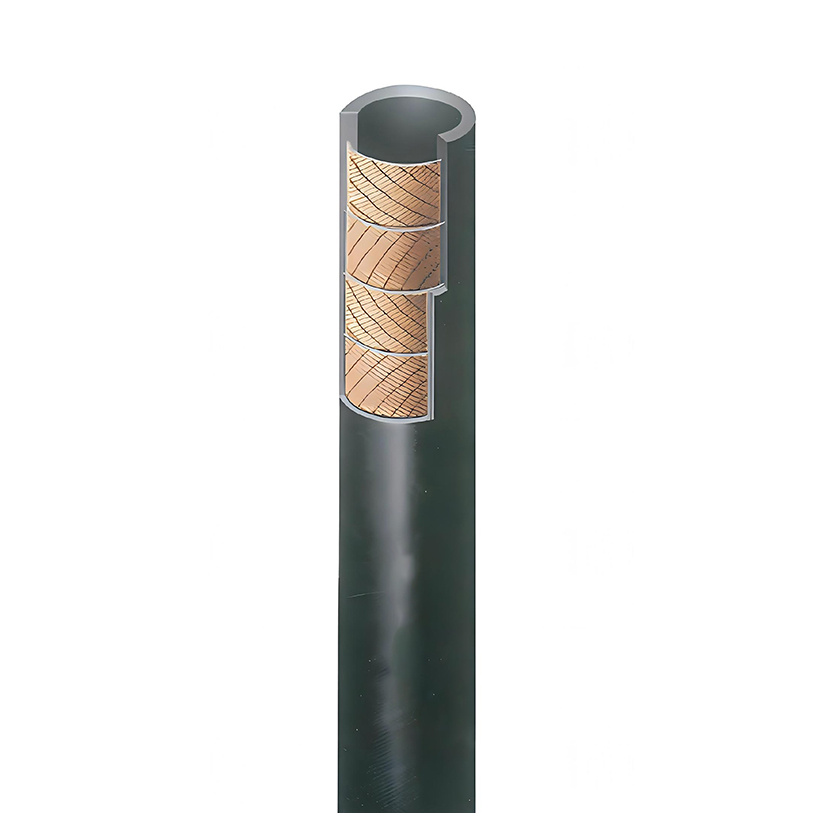
A heavy-duty oilfield suction assembly normally combines an application-compatible inner tube, textile reinforcement, steel wire helix and protective outer cover.
The construction must balance drilling-fluid compatibility, positive-pressure strength, vacuum resistance and installation flexibility.
Oil- and Abrasion-Resistant Inner Tube
The inner tube remains in direct contact with the drilling fluid.
For suitable applications, NBR or another selected oil-resistant synthetic rubber can provide resistance to drilling mud, hydrocarbon contamination and abrasive solids.
WBM can create different chemical conditions from oil-based or synthetic-based mud. For demanding fluids, the drilling-fluid specification and available chemical information should therefore form part of the material review.
Textile Reinforcement
High-strength textile reinforcement supports positive internal pressure while preserving the flexibility required for drilling-rig installation.
The reinforcement arrangement depends on hose diameter, working pressure, vacuum duty, overall length and operating conditions.
Steel Wire Helix Reinforcement
A Wire Reinforced Mud Pump Suction Hose uses one or more steel wire helices within the hose wall.
When negative pressure develops at the pump inlet, the helix provides structural support and helps maintain the internal flow passage. It also improves kink resistance and stability near pump and manifold connections.
Related buyer terminology includes Steel Wire Oilfield Suction Hose, Wire Helix Suction Hose, Heavy Duty Mud Pump Suction Hose and Oilfield Vacuum Hose.
Heavy-Duty Outer Cover
The outer cover protects the assembly from routine drilling-rig exposure.
Mud contamination, oil splash, contact with steel structures, sunlight, rain and repeated handling can all affect service life. The cover therefore requires suitable resistance to abrasion, cuts, scuffs, ozone and weather.
For offshore or severe-abrasion applications, SGPE can review additional cover protection and end-fitting corrosion requirements according to the project environment.
Working Pressure, Vacuum & Full-Vacuum Service
Positive working pressure and negative pump suction create different loading conditions, so buyers should evaluate them separately.
| Hose Configuration | Working Pressure Reference | Vacuum Requirement | Typical Application |
|---|---|---|---|
| Standard Mud Suction Hose | Project-specific | High / full vacuum | Mud pump inlet |
| 150 PSI Oilfield Suction Hose | 150 PSI / 10 Bar | Application-specific | Suction / low-pressure transfer |
| Full Vacuum Mud Pump Suction Hose | Project-specific | Full vacuum | Strong pump suction |
| Mud Suction and Discharge Hose | Positive pressure + vacuum | Application-specific | Suction and mud transfer |
| Higher-Pressure Suction & Discharge Hose | Project-specific | Project-specific | Selected transfer service |
A hose may withstand positive internal pressure yet still lack sufficient structural support for strong suction. SGPE therefore considers working pressure, vacuum duty and the complete suction-system arrangement separately.
What Does Full Vacuum Mean?
A Full Vacuum Mud Pump Suction Hose maintains its internal flow area when the pump creates strong negative pressure.
Without sufficient reinforcement, negative pressure can pull the hose wall inward and reduce the available bore. The resulting restriction increases suction loss and can reduce pump filling.
Poor filling conditions may contribute to unstable drilling-fluid supply, vibration or cavitation. Repeated collapse can also shorten hose life.
Full-vacuum capability becomes particularly important with high-capacity triplex mud pumps, slush pumps, dense drilling fluids, long suction lines, restricted tank outlets and large 6 in. or 8 in. hoses.
For demanding applications, provide the mud pump model, flow rate, mud density and suction-system arrangement with the RFQ.
Mud Suction Hose Size Guide
SGPE commonly reviews hose requirements from 2 in. through 8 in. I.D.
| Nominal I.D. | Metric I.D. | Typical Oilfield Application | Main Selection Focus |
|---|---|---|---|
| 2″ | 50.8 mm | Auxiliary drilling-fluid and workover lines | Flow |
| 3″ | 76.2 mm | Service rig and mud-transfer lines | Pump capacity |
| 4″ | 101.6 mm | Mud pump, slush pump and mud tank connections | Flow + vacuum |
| 5″ | 127.0 mm | Medium/high-volume mud systems | Pump inlet |
| 6″ | 152.4 mm | Large mud pumps and active mud tanks | Suction loss |
| 8″ | 203.2 mm | High-capacity drilling-fluid systems | Vacuum + routing |
An undersized hose can increase fluid velocity and suction loss. Buyers should therefore review diameter together with flow rate, mud density, overall length and the complete pump-inlet arrangement.
4 Inch Mud Pump Suction Hose
A 4 Inch Mud Pump Suction Hose can suit moderate-flow mud pump, mud tank, mud pit and transfer-pump applications.
Buyers may also describe this size as a 4 Inch Oilfield Suction Hose or 4 Inch Mud Suction and Discharge Hose.
Final working pressure, vacuum capability, O.D. and minimum bend radius depend on the approved construction.
6 Inch Full Vacuum Suction Hose
A 6 Inch Mud Pump Suction Hose commonly serves larger pumps and active mud systems.
Its larger bore can help reduce fluid velocity and suction loss compared with an undersized line, although it also requires more routing space and closer attention to support and bend radius.
Other common descriptions include 6 Inch Full Vacuum Hose and Large Bore Oilfield Suction Hose.
SGPE confirms final dimensions and installation requirements in the approved TDS or drawing.
8 Inch Large Bore Suction Hose
An 8 Inch Mud Pump Suction Hose can support high-capacity drilling-fluid systems and large mud-pump installations.
Large-bore hose assemblies experience greater structural loading under suction, so reinforcement, routing, support and installation clearance become particularly important.
For an 8 in. full-vacuum application, SGPE recommends reviewing the complete suction arrangement before confirming the final assembly.
Mud Suction Hose Applications
Oilfield suction hoses can serve several low-pressure sections of a drilling-fluid system.
| Oilfield Application | Typical Hose Requirement | Main Selection Focus |
|---|---|---|
| Mud Pump Inlet | Full Vacuum Mud Pump Suction Hose | Flow + vacuum |
| Mud Pump Suction Line | Mud Pump Inlet Hose | I.D. + suction loss |
| Slush Pump Inlet | Slush Pump Suction Hose | Vacuum + connection |
| Mud Pit to Pump | Mud Pit Suction Hose | Length + flow |
| Active Mud Tank | Large Bore Oilfield Suction Hose | I.D. + routing |
| Reserve Mud Tank | Mud Tank Suction Hose | Length + fittings |
| Suction Manifold | Flanged Suction Hose | End connections |
| Tank-to-Tank Transfer | Mud Suction and Discharge Hose | Pressure + fluid |
| Mud Transfer Pump | Mud Transfer Hose | Pump conditions |
| Centrifugal Mud Pump | Vacuum-Resistant Oilfield Hose | Inlet conditions |
| Mud Mixing System | Drilling Fluid Transfer Hose | Abrasion + flow |
| Workover Fluid Tank | Oilfield Suction Hose | Fluid + temperature |
| Workover Mud Pump | Mud Pump Suction Hose | Space + routing |
| Mud-System Retrofit | Custom Suction Assembly | Existing interfaces |
| Mature Rig MRO | Replacement Pump Suction Hose | Dimensions |
| Offshore Mud Module | Offshore Suction Hose | Environment + documentation |
Land drilling rigs can expose the hose to frequent rig-up and rig-down, mud contamination, steel structures and outdoor weather.
Offshore installations place greater emphasis on controlled routing, fitting corrosion, hose identification and project documentation. Workover rigs may offer less installation space, making overall length and minimum bend radius more critical.
Brownfield and MRO projects present a different challenge because a replacement Mud Suction Hose must match the existing pump, manifold and piping layout.
WBM, OBM & SBM Compatibility
The inner-tube compound should match the actual drilling fluid rather than the nominal hose size alone.
| Drilling Fluid | Typical Characteristics | Main Selection Concern |
|---|---|---|
| WBM | Water, bentonite, barite, salts, polymers | Abrasion + chemical resistance |
| OBM | Oil-based continuous phase + solids | Oil resistance |
| SBM | Synthetic base fluid + additives | Elastomer compatibility |
| Weighted Mud | High barite / solids loading | Abrasion + flow |
| Brine / Workover Fluid | Salt solution + additives | Chemical compatibility |
A Water-Based Mud Pump Suction Hose may carry bentonite, barite, salts, polymers, lubricants and drilled solids, so suitable chemical and abrasion resistance matters.
For oil-based mud, the selected elastomer must suit the actual base fluid and mud formulation. Useful information includes the base oil type, mud density, operating temperature and available fluid data.
Synthetic-based mud may require a separate compatibility review because different formulations can affect elastomers differently. For demanding SBM service, provide the available drilling-fluid specification before final material confirmation.
Mud Suction Hose End Connections
SGPE can supply complete assemblies with different End A and End B connections.
| End Connection | Typical Application | Information to Confirm |
|---|---|---|
| Flanged End | Mud pump / tank / manifold | Size, class, dimensions |
| Hose Nipple | Flexible hose assembly | Diameter |
| Suction-Hose Union | Mud / slush pump system | Size + union details |
| Threaded End | Auxiliary mud piping | Thread designation |
| Grooved Coupling | Selected mud lines | Groove specification |
| Cam & Groove | Temporary / service line | Size + material |
| Fabricated Pipe End | Custom mud system | Drawing |
| Custom Adapter | Replacement assembly | Existing interface |
A Flanged Mud Pump Suction Hose should match the actual mating equipment rather than a generic flange description.
For replacement work, provide the flange size, outside diameter, bolt circle, bolt-hole quantity and clear photographs of both ends. End A and End B may use different connections, so buyers should confirm each interface separately.
How to Select the Correct Mud Suction Hose
Correct selection begins with the complete drilling-fluid system rather than a catalogue size alone.
Hose I.D. affects fluid velocity and suction loss, so buyers should check diameter against the required flow rate, mud density and pump-inlet conditions instead of simply copying an existing flange size. An undersized line can increase suction losses, while an unnecessarily large assembly can create installation and support issues.
Working pressure and vacuum require separate review. Positive pressure may occur during operation, flushing or transfer, while the pump inlet creates a negative-pressure condition that depends heavily on reinforcement and system layout.
Drilling-fluid chemistry determines the inner-tube material. Buyers should identify whether the system uses WBM, OBM or SBM and provide additional fluid information whenever the formulation is chemically demanding. Fluid and ambient temperatures also influence elastomer selection.
Overall length and minimum bend radius determine whether the hose can follow a natural route without excessive tension, sagging or sharp bending. These factors become increasingly important as hose diameter increases.
Finally, End A and End B must match the actual mating equipment. Drawings, measured dimensions and field photographs greatly reduce the risk of ordering the correct bore with incorrect fittings.
Custom & Replacement Mud Pump Suction Hose Assemblies
SGPE supports custom hose requirements for new drilling rigs, mud-system packages, brownfield upgrades and oilfield MRO.
A custom assembly may require a specific I.D., working pressure, vacuum capability, tube compound, reinforcement, overall length or end-connection arrangement. Special flanges, protective sleeves, anti-static construction, identification markings and additional inspection documentation can also be reviewed where required.
For a Replacement Mud Pump Suction Hose, the new assembly must match both the operating conditions and installed geometry.
| Existing Information | Why It Matters |
|---|---|
| Hose Marking | Helps identify existing size and rating |
| Existing Drawing | Provides dimensions and interface data |
| Hose I.D. / O.D. | Helps identify construction |
| Overall Length | Maintains existing routing |
| End A / End B | Confirms mating interfaces |
| Flange Dimensions | Supports correct replacement |
| Thread / Union Data | Identifies connection |
| Mud Pump Model | Confirms application |
| Pump Inlet Size | Checks system interface |
| Working Pressure | Defines positive-pressure requirement |
| Vacuum Requirement | Defines suction duty |
| Mud Type | Supports tube selection |
| Field Photographs | Shows routing and mating equipment |
| Existing Part Number | Supports cross-reference |
Matching only the nominal I.D. does not guarantee a successful replacement. A hose can have the correct bore yet fail to fit because its overall length, flange dimensions or end-fitting arrangement differs from the original assembly.
For older rigs where original supplier information is no longer available, markings, measured dimensions, photographs and pump information can often provide enough information to begin the replacement review.
Mud Suction Hose vs. API 7K Drilling Hose
The term Mud Pump Hose can refer to several different products, so buyers should confirm the installation point before selecting a hose.
| Hose Type | Typical Position | Pressure Service | Main Function |
|---|---|---|---|
| Mud Pump Suction Hose | Before mud pump | Suction / low pressure | Supplies mud to pump |
| Mud Suction and Discharge Hose | Low-pressure mud system | Suction + pressure | Transfers drilling fluid |
| API 7K Vibrator Hose | Mud pump discharge | High pressure | Carries pump discharge |
| API 7K Mud Jumper Hose | Surface mud manifold | High pressure | Flexible crossover |
| API 7K Rotary Hose | Standpipe to swivel / Top Drive | High pressure | Carries drilling mud |
A conventional Mud Suction Hose operates upstream of the pump and places greater emphasis on vacuum resistance.
API 7K Vibrator Hose, Mud Jumper Hose and Rotary Hose serve high-pressure sections of the drilling-fluid circulation system. Buyers should not treat these products as interchangeable simply because they all carry drilling mud.
Inspection, Testing & Documentation
Depending on the agreed project scope, SGPE can support inspection and documentation requirements for drilling contractors, EPC packages, offshore projects and oilfield MRO orders.
| Inspection / Document | Typical Purpose |
|---|---|
| Approved Technical Data Sheet | Confirms final configuration |
| Dimensional Drawing | Confirms hose and fittings |
| Material Information | Records specified construction |
| Dimensional Inspection | Confirms assembly dimensions |
| End-Fitting Inspection | Confirms interfaces |
| Pressure Test | Verifies agreed pressure performance |
| Vacuum Verification | Supports suction requirement |
| Visual Inspection | Checks workmanship |
| Hose Marking Check | Confirms identification |
| Final Inspection | Supports release |
| Pressure / Vacuum Test Records | Records agreed test results |
| Packing Documentation | Supports export delivery |
| Third-Party Inspection | Supports ITP / witness requirements |
Standard replacement orders may require only basic dimensional, visual and agreed pressure or vacuum verification.
EPC, offshore and oil-company projects can require a broader document package, including approved drawings, inspection records, ITP requirements and third-party witness points.
If the project includes a specific inspection plan or document list, provide these requirements during the RFQ stage so SGPE can incorporate them into the technical and commercial review.
Why Choose SGPE as a Mud Suction Hose Supplier?
SGPE focuses on petroleum drilling and oilfield equipment rather than general industrial hose applications. This background allows the hose to be reviewed as part of the actual drilling-fluid circulation system rather than as an isolated rubber component.
For standard requirements, SGPE reviews hose I.D., working pressure, vacuum duty, drilling fluid, overall length and end connections. More demanding applications may also require flow rate, mud density, operating temperature, minimum bend radius, rig layout and inspection requirements.
For drilling contractors, a replacement review may begin with an existing hose, mud pump model and field photographs. EPC projects may instead begin with a technical datasheet, piping drawing, ITP and project document list.
This application-based approach helps align the assembly with the actual installation before SGPE confirms the final configuration.
SGPE supports international drilling contractors, EPC companies, oilfield service companies and equipment distributors seeking a China Mud Suction Hose Supplier, Mud Pump Suction Hose Supplier or Full Vacuum Suction Hose Supplier for new drilling projects, replacement requirements and repeat MRO procurement.
Related Drilling Hose & Mud System Equipment
The pump-inlet hose works on the low-pressure side of the drilling-fluid system, while other parts of the circulation or well-control package require different hose designs.
SGPE can coordinate API 7K Rotary Hose for standpipe-to-swivel or Top Drive service, API 7K Vibrator Hose for mud pump discharge connections and API 7K Mud Jumper Hose for high-pressure surface mud-manifold crossovers.
Related project requirements can also include API 7K Cement Hose, API 16C Choke and Kill Hose and API 16D BOP Control Hose.
Where required, the same sourcing package can include Drilling Mud Pumps, Mud Pump Spare Parts and Mud Manifold Equipment.
For new drilling projects, coordinated sourcing can reduce the number of suppliers involved in the mud-system package. For replacement work, customers can purchase only the required suction assembly while retaining the existing pump, tank and piping system.
Mud Suction Hose Price & Quotation Factors
Buyers requesting a Mud Suction Hose price, 6 in. or 8 in. pump suction hose price, full-vacuum hose quotation or flanged assembly quotation should provide the actual operating conditions rather than only the nominal diameter.
One fixed price cannot represent every assembly because hose construction, overall length and end fittings vary with the application.
| Price Factor | Effect on Quotation |
|---|---|
| Hose I.D. | Changes material quantity |
| Working Pressure | Changes construction |
| Vacuum Requirement | Changes reinforcement |
| Overall Length | Changes material quantity |
| Tube Compound | Depends on fluid compatibility |
| Wire Reinforcement | Changes hose construction |
| Outer Cover | Changes protection |
| End A / End B | Changes fitting cost |
| Flange / Union Size | Changes connection cost |
| Fitting Material | Affects material cost |
| Protective Sleeve | Adds local protection |
| Custom Dimensions | Adds fabrication requirements |
| Pressure / Vacuum Testing | Changes QA scope |
| Third-Party Inspection | Adds inspection coordination |
| Documentation | Changes dossier scope |
| Quantity | Affects production planning |
| Delivery Destination | Affects packing and logistics |
For an efficient quotation process, send the operating conditions together with the required quantity and delivery destination.
For replacement orders, existing hose markings, connection measurements, drawings and field photographs can reduce the number of technical clarifications required before pricing.
Mud Suction Hose RFQ Data Sheet
Use the following information when available.
| RFQ Item | Information to Provide |
|---|---|
| Product | Mud Suction Hose / Mud Suction and Discharge Hose |
| Quantity | Required quantity |
| Application | Mud pump / slush pump / mud pit / tank / manifold |
| Rig Type | Land / jack-up / offshore / drillship / workover |
| Hose I.D. | 2″, 3″, 4″, 5″, 6″, 8″ or other |
| Working Pressure | Maximum positive pressure |
| Vacuum Requirement | High vacuum / full vacuum / project data |
| Flow Rate | GPM / L/min |
| Mud Density | ppg / SG |
| Drilling Fluid | WBM / OBM / SBM |
| Fluid Composition | Where required |
| Temperature | Minimum / maximum |
| Overall Length | Required length |
| Minimum Bend Radius | If specified |
| End A | Complete connection |
| End B | Complete connection |
| Flange Data | Size / class / dimensions |
| Thread / Union | Full designation |
| Fitting Material | Project requirement |
| Anti-Static Requirement | If required |
| Protective Sleeve | If required |
| Pressure / Vacuum Test | Required scope |
| Inspection | Customer / TPI requirement |
| Documentation | Required records |
| Mud Pump Model | If available |
| Pump Inlet Size | If available |
| Existing Drawing | Replacement project |
| Existing Hose Marking | Clear photograph |
| Field Photographs | Hose + mating equipment |
| Existing Part Number | If available |
| Destination | Country / project location |
A complete datasheet is not required to start a replacement enquiry. If some technical information is unavailable, send the existing hose marking, measured dimensions, mud pump information and clear photographs first. SGPE can use these references to identify the remaining information required for quotation.
Frequently Asked Questions About Mud Pump Suction Hoses
1. What is a Mud Suction Hose and where does it work on a drilling rig?
A Mud Suction Hose provides a flexible, vacuum-resistant connection on the low-pressure inlet side of a drilling-fluid circulation system. It transfers conditioned drilling mud from an active mud tank, mud pit or suction manifold toward the mud pump while helping maintain an open internal flow passage under suction.
A typical drilling-fluid suction arrangement follows this path:
Mud Tank / Mud Pit → Suction Manifold → Suction Hose → Mud Pump
Depending on rig terminology, operators may also call the product a Mud Pump Suction Hose, Mud Pump Inlet Hose, Slush Pump Suction Hose, Mud Pit Suction Hose or Oilfield Suction Hose.
Land rigs, offshore platforms, jack-up rigs, drillships and workover units commonly use these assemblies to connect rigid mud-system piping with the mud pump inlet.
2. How does a Mud Pump Suction Hose differ from a Mud Suction and Discharge Hose?
A Mud Pump Suction Hose primarily handles vacuum service on the inlet side of the pump. Its reinforcement helps the hose maintain its internal bore as negative pressure develops.
A Mud Suction and Discharge Hose handles both suction and positive low-pressure transfer. Operators may use it for tank-to-tank transfer, centrifugal mud pumps, temporary drilling-fluid lines and other low-pressure mud-transfer applications.
Working pressure, vacuum requirement, hose diameter, drilling-fluid chemistry, operating temperature and end connections all influence the correct configuration. A hose that handles positive-pressure transfer does not automatically provide sufficient full-vacuum performance.
3. Is a Mud Suction Hose the same as an API 7K Mud Pump Hose?
No. A conventional suction hose normally operates upstream of the mud pump under vacuum or relatively low positive pressure, while API 7K drilling hoses serve high-pressure sections of the drilling-fluid circulation system.
An API 7K Vibrator Hose normally carries mud from the mud-pump discharge system toward the standpipe manifold. An API 7K Mud Jumper Hose provides flexible high-pressure connections between surface mud-line or manifold sections, while an API 7K Rotary Hose carries drilling fluid between the standpipe and the swivel or Top Drive.
A high PSI rating alone does not make a hose suitable for pump-inlet suction. Buyers should also consider vacuum resistance, reinforcement structure and collapse performance.
4. What sizes of Mud Suction Hose are commonly used in oilfield drilling?
SGPE commonly reviews 2″, 3″, 4″, 5″, 6″ and 8″ Mud Suction Hose requirements for drilling-fluid suction and low-pressure transfer systems.
A 4 in. assembly can suit moderate-flow mud pump and mud tank applications. A 6 Inch Mud Pump Suction Hose often serves larger pumps where suction loss becomes more important, while an 8 in. large-bore hose can support higher-capacity drilling-fluid systems.
Flow rate, mud density, overall hose length, suction-system layout and available routing space should guide the final diameter selection rather than pump-inlet or flange size alone.
5. Is 150 PSI suitable for mud pump suction service?
A 150 PSI Mud Suction Hose can suit many low-pressure oilfield mud suction and drilling-fluid transfer applications, including mud pump inlets, active mud tanks and suction manifolds.
However, positive working pressure only describes part of the operating condition. The hose must also maintain its internal bore when the mud pump creates negative pressure.
SGPE therefore reviews positive working pressure and vacuum duty separately and considers hose diameter, flow conditions and suction-system layout before selecting the final configuration.
6. What does Full Vacuum Mud Suction Hose mean?
A Full Vacuum Mud Suction Hose uses structural reinforcement to help maintain its internal flow area when strong negative pressure develops at the mud pump inlet.
Without enough reinforcement, negative pressure can pull the hose wall inward and reduce the effective bore. This restriction increases suction loss and may reduce pump filling efficiency.
Steel wire helices commonly provide the structural support needed to resist collapse while preserving enough flexibility for field installation. Full-vacuum construction becomes particularly important with high-capacity triplex mud pumps, dense drilling fluids, long suction lines and larger 6 in. or 8 in. assemblies.
7. Can a Mud Suction Hose handle WBM, OBM and SBM?
Yes, when the selected inner-tube compound matches the actual drilling-fluid chemistry.
Water-based mud may contain bentonite, barite, salts, polymers, lubricants and abrasive drilled solids, so the hose needs suitable chemical and abrasion resistance. Oil-based mud requires an elastomer with appropriate resistance to the base oil and other hydrocarbon components. Synthetic-based mud may require a separate compatibility review because different base fluids and additive packages can affect elastomers differently.
For demanding OBM or SBM service, provide the available fluid specification, mud density, operating temperature and base-fluid information so SGPE can review the appropriate tube material.
8. Can SGPE supply custom and replacement Mud Suction Hoses?
Yes. SGPE supports Custom Mud Suction Hose and replacement requirements for new drilling rigs, brownfield upgrades, EPC mud-system packages, drilling contractors and oilfield MRO programs.
SGPE can review hose I.D., working pressure, vacuum capability, drilling-fluid type, overall length, reinforcement, End A, End B, flange dimensions and additional protection or inspection requirements according to the project.
If the original datasheet is unavailable, buyers can provide existing hose markings, measured dimensions, mud pump information, old drawings and clear field photographs. SGPE can use these references to identify the remaining technical information needed for the replacement review.
9. What end connections are available for a Mud Suction Hose?
Project configurations can include flanged ends, hose nipples, suction-hose unions, threaded connections, grooved couplings, cam and groove fittings, fabricated pipe ends and custom adapters.
End A and End B can use different connections when the hose joins equipment with different interfaces.
For a Flanged Mud Suction Hose or replacement assembly, provide the flange size, outside diameter, bolt circle, bolt-hole quantity and clear photographs of both ends. Accurate interface information helps prevent fit-up problems during installation.
10. How should I select the hose length and minimum bend radius?
The hose should follow a natural route between the mud tank, suction manifold and mud pump without sharp bends, continuous tension or excessive sagging.
A hose that is too short can pull against the end fittings and transfer unnecessary mechanical load to pump or piping connections. An excessively long hose may sag, rub against structural steel or create additional bends that increase suction loss and external wear.
Minimum bend radius becomes especially important for large-bore 6 in. and 8 in. hoses. Hose size and construction determine the final bend radius, and SGPE provides the applicable value in the approved technical data sheet or drawing.
11. What information should I provide for a Replacement Mud Pump Suction Hose?
For a Replacement Mud Pump Suction Hose, provide the existing hose marking, I.D., O.D. where available, overall length, End A and End B details, flange or union dimensions, mud pump model, pump inlet size, working pressure, vacuum requirement, drilling-fluid type and operating temperature.
Clear photographs of the complete hose, both end connections and the surrounding installation can greatly improve the replacement review, especially for brownfield and oilfield MRO projects.
If you have an old drawing, tag number or existing part number, include it with the enquiry. Matching only the nominal hose diameter does not guarantee correct fit because overall length, fitting geometry and connection dimensions may differ between drilling rigs.
12. What information should I provide for a Mud Suction Hose price and quotation?
For an accurate Mud Suction Hose quotation, provide the hose I.D., working pressure, vacuum requirement, flow rate, mud density, drilling-fluid type, operating temperature, overall length, End A, End B and required quantity.
Rig type and installation location also help SGPE review the application because land rigs, offshore platforms, jack-up rigs and workover units can have different routing, corrosion, inspection and documentation requirements.
For EPC and offshore projects, buyers should also identify any pressure or vacuum testing, third-party inspection, drawing, ITP or project-documentation requirements that need to form part of the quotation.
If you do not have a complete specification for a replacement hose, send the existing hose marking, connection measurements, mud pump information and clear field photographs first. SGPE can use these references to complete the technical review and prepare the corresponding quotation.
Request a Mud Suction Hose Quotation from SGPE
SGPE supplies standard, full-vacuum, flanged, large-bore, custom and replacement Mud Suction Hose assemblies for land, offshore and workover drilling-fluid systems.
For a new requirement, provide the hose I.D., working pressure, vacuum requirement, flow rate, mud type, overall length, End A, End B and quantity. For replacement projects, existing hose markings, connection dimensions, mud pump information, drawings and clear field photographs can help confirm the required configuration.
Email: info@sgpe.com
Tel/Whatsapp: +86 186-1599-5239