Description
Type T Safety Clamp for Oilfield Tubing, Flush-Joint Pipe, Drilling, Well Completion & Workover
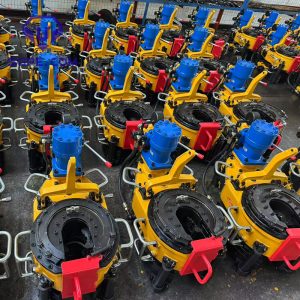
SGPE Type T Safety Clamp is a mechanical oilfield handling tool that provides secondary anti-slip restraint for small-diameter tubulars during drilling, well completion, workover and well servicing. It helps crews control compatible flush-joint tubing, production tubing and smooth-bodied pipe during connection work and other approved rig-floor operations.
Also known as a WA-T Safety Clamp or T Type Safety Clamp, the tool features hinged alloy steel links, spring-loaded tapered gripping inserts and a manual screw-and-nut tightening mechanism. The linked body wraps around the pipe, allowing several gripping elements to contact its surface.
SGPE offers 4-link, 5-link and 6-link WA-T configurations for specified pipe outside diameters from 1-1/8 to 4-1/2 in (28.6–114.3 mm). Each configuration has a defined gripping range, making the actual pipe O.D. essential for model selection.
The range supports selected operations involving tubing running and pulling, flush-joint pipe handling, connection make-up and break-out, oilfield workover, well completion and recompletion. Its manual design also suits approved tubular-handling procedures on land drilling rigs, pulling units and selected offshore equipment.
SGPE supplies complete WA-T assemblies and supports enquiries for compatible gripping inserts, replacement links, springs and tightening components. Customers can also request dimensional cross-reference assistance for common A11-125, A11-126, A11-127 and 7624-series Type T Safety Clamp requirements.
Need a Type T Safety Clamp for your tubing program? Send SGPE the actual pipe O.D., tubular type, required quantity and destination for technical review and quotation.
Email: info@sgpe.com
Tel / WhatsApp: +86 186-1599-5239
Type T Safety Clamp Technical Specifications
The SGPE WA-T series uses a hinged multi-link assembly and mechanical wedge-type gripping system. It operates manually without hydraulic, pneumatic or electrical power.
General Product Specifications
| Technical Parameter | Specification |
|---|---|
| Product Name | Type T Safety Clamp |
| Alternative Names | WA-T Safety Clamp, T Type Safety Clamp |
| Brand | SGPE |
| Model Series | WA-T |
| Product Category | Oilfield Safety Clamp / Tubular Handling Tool |
| Primary Function | Secondary anti-slip restraint |
| Published Pipe O.D. Range | 1-1/8 to 4-1/2 in, depending on configuration |
| Approximate Metric Range | 28.6 to 114.3 mm |
| Standard Configurations | 4-link, 5-link and 6-link |
| Main Construction | High-strength alloy steel components |
| Clamp Structure | Hinged multi-link assembly |
| Gripping Mechanism | Spring-loaded tapered inserts |
| Gripping Principle | Mechanical wedge action |
| Tightening System | Manual screw-and-nut mechanism |
| Operating Method | Manual |
| External Power | Not required |
| Main Tubular Applications | Flush-joint tubing, production tubing and compatible small-diameter pipe |
| Typical Operations | Tubing running, pulling, connection handling, completion and workover |
| Operating Equipment | Land drilling rigs, workover rigs, pulling units and selected offshore units |
| Referenced Standard | Applicable API Spec 7K requirements |
| Hoisting Function | Non-hoisting auxiliary restraint |
| Replacement Components | Gripping inserts, links, springs, pins and tightening parts |
| Supply Enquiries | Complete assemblies and compatible spare parts, subject to availability |
The published diameter limits apply to individual WA-T configurations. They do not form one continuous approved gripping range.
Additional Engineering Information for Procurement
Before ordering, oilfield buyers may need the clamp’s actual assembly weight, overall dimensions, link geometry, material specifications and gripping insert details.
Replacement projects often require closer dimensional checks. For example, the buyer may need to identify an insert’s tooth profile, a link’s mounting dimensions or the original tightening screw.
Offshore projects may also require specific surface protection, material traceability, inspection reports or other quality documents.
Include these requirements in your RFQ so SGPE can confirm the information available for the selected model.
Specifications, weights and materials published by other manufacturers do not automatically apply to SGPE equipment.
WA-T Type T Safety Clamp Models and Size Chart
Choosing the correct WA-T assembly starts with the actual outside diameter at the intended gripping location.
Standard WA-T Safety Clamp Size Ranges
| Model | Pipe O.D. Range (in) | Approx. O.D. Range (mm) | Number of Links |
|---|---|---|---|
| WA-T 4-Link | 1-1/8 – 2 | 28.6–50.8 | 4 |
| WA-T 5-Link | 2-1/8 – 3-1/4 | 54.0–82.6 | 5 |
| WA-T 6-Link | 3-1/2 – 4-1/2 | 88.9–114.3 | 6 |
The metric values are approximate conversions of the published inch dimensions, not separate manufacturing tolerances.
Each model has a specified gripping range. Operators must use the manufacturer-approved link arrangement and should not add or remove links without technical authorization.
The standard size ranges contain two gaps: pipe diameters between 2 and 2-1/8 in, and between 3-1/4 and 3-1/2 in. These dimensions require separate technical confirmation rather than automatic selection of an adjacent model.
Common Oilfield Tubing Sizes and WA-T Model Selection
Oilfield purchasing teams often search for a safety clamp by the pipe diameter, particularly when replacing equipment for an existing tubing program.
The following table provides preliminary size matching.
| Actual Pipe O.D. | Approx. O.D. (mm) | Preliminary WA-T Configuration |
|---|---|---|
| 1.315 in | 33.4 | 4-Link |
| 1.660 in | 42.2 | 4-Link |
| 1.900 in | 48.3 | 4-Link |
| 2-3/8 in | 60.3 | 5-Link |
| 2-7/8 in | 73.0 | 5-Link |
| 3-1/2 in | 88.9 | 6-Link |
| 4 in | 101.6 | 6-Link |
| 4-1/2 in | 114.3 | 6-Link |
For example, a 2-3/8 in tubing safety clamp requirement falls within the published five-link WA-T range. The same configuration also provides a preliminary match for a 2-7/8 in Type T Safety Clamp requirement.
For 3-1/2 in and 4-1/2 in pipe bodies, the six-link configuration provides the starting point.
However, a diameter match alone does not guarantee compatibility. The final selection must also account for connection geometry, available gripping length, pipe material, surface condition and gripping insert design.
For special sizes, coated pipe or premium tubing, confirm the complete tubular specification before ordering.
Common Type T Safety Clamp Model Numbers and Replacement References
Drilling contractors and well-service companies often identify existing safety clamps by the original equipment number.
Common Type T references include A11-125, A11-126, A11-127, 7624-5103, 7624-5104 and 7624-5105. These numbers help procurement teams identify an existing assembly when searching for replacement equipment.
Industry Type T Safety Clamp Model References
| Links | Keystone Energy Tools Model | Published Reference | Texas International Model |
|---|---|---|---|
| 4 | A11-125 | 7624-5103 | T7624-5044 |
| 5 | A11-126 | 7624-5104 | T7624-5045 |
| 6 | A11-127 | 7624-5105 | T7624-5046 |
Keystone Energy Tools publishes A11-125, A11-126 and A11-127 for its four-link, five-link and six-link Type T assemblies. Texas International Oilfield Tools uses the T7624-series designations shown above.
Although these products share similar link configurations, their published specifications are not identical.
For example, Keystone lists a six-link working range of 3-1/2 to 4-1/2 in, while Texas International lists 3-1/4 to 4-1/2 in for its corresponding model.
The table groups third-party models by link count for identification only. It does not establish direct interchangeability, equivalent dimensions or confirmed SGPE stock availability.
Replacement Type T Safety Clamp Enquiries
For an A11-125 replacement, A11-126 replacement, A11-127 replacement or 7624-series Type T Safety Clamp, provide the original manufacturer, complete model number and pipe O.D.
Photographs of the clamp body, links, tightening mechanism and nameplate can help identify differences between manufacturers. If dimensional drawings are available, include them with the enquiry.
For replacement gripping inserts or other parts, provide the original part number, dimensions and retention details.
SGPE can review the technical information before confirming a suitable replacement option.
Type T Safety Clamp Design and Working Principle
A Type T Safety Clamp uses connected links and tapered gripping inserts to provide supplementary restraint around a compatible tubular.
Its mechanical design supports approved rig-floor procedures where crews need additional protection against unintended pipe movement.
Hinged Multi-Link Construction
Individual alloy steel links connect through hinged joints to form the clamp body.
The segmented assembly wraps around the pipe circumference. Different link counts provide different effective gripping ranges for small-diameter tubulars.
The construction also allows maintenance personnel to inspect links and connecting components for wear or damage.
Spring-Loaded Tapered Gripping Inserts
Each gripping link contains a tapered insert supported by a spring.
When the operator tightens the clamp, the inserts contact the pipe surface. If the tubular moves downward relative to the assembly, the wedge geometry can increase gripping contact.
This action helps resist further movement.
However, worn insert teeth, damaged springs, incorrect sizing or unsuitable pipe surfaces can affect performance.
Manual Screw-and-Nut Tightening
The screw-and-nut mechanism secures the linked assembly around the tubular.
Operators use the specified wrench and follow the manufacturer’s tightening and release instructions.
The clamp needs no hydraulic hoses, compressed-air supply or electrical connection. However, excessive tightening or incorrect inserts may damage the pipe surface, particularly on coated or premium tubulars.
Important Operating Limitation
A standard Type T Safety Clamp provides secondary anti-slip restraint. It must not independently lift, suspend or carry the tubular string weight.
Suitable slips, spiders and approved hoisting equipment must perform their designated load-bearing functions.
Key Features and Benefits of SGPE WA-T Safety Clamps
Additional Protection for Flush-Joint Tubing
Flush-joint tubing may require extra handling precautions because its connection profile lacks the pronounced external shoulder found on some other tubulars.
The WA-T clamp provides an auxiliary gripping arrangement around the approved pipe section while suitable primary equipment supports the string.
Three Standard Size Configurations
SGPE offers four-link, five-link and six-link models for different pipe O.D. ranges.
The published size chart gives buyers a practical starting point for equipment selection and replacement procurement.
Manual Operation Without External Power
The clamp uses a mechanical tightening system rather than a hydraulic or pneumatic drive.
This makes it practical for selected conventional drilling, completion and workover equipment arrangements.
Serviceable Alloy Steel Construction
The assembly uses high-strength alloy steel links and serviceable mechanical components.
Maintenance personnel can inspect gripping inserts, springs, pins and tightening hardware individually, helping them identify damaged parts before returning the clamp to service.
Type T Safety Clamp Applications in Oil and Gas Operations
1. Flush-Joint Tubing and Integral-Joint Pipe Handling
Flush-joint tubing has a relatively smooth external connection profile. As a result, crews may require additional restraint during connection make-up and break-out.
A correctly selected Flush-Joint Tubing Safety Clamp provides supplementary contact around the approved gripping section while suitable primary equipment supports the tubular string.
This arrangement helps crews manage compatible tubing during completion, workover and well servicing.
Some integral-joint pipe designs have similar handling requirements. However, buyers must confirm the actual gripping diameter, connection profile and available contact length before selecting a clamp.
2. Production Tubing Running and Well Completion
During well completion, crews run production tubing into the well and connect individual joints at the rig floor.
Tubing elevators lift and position the pipe, while suitable slips or other approved equipment support the string during connection work.
Where the operating procedure requires additional restraint, a Type T Safety Clamp for production tubing can provide supplementary gripping protection.
The WA-T series covers selected production tubing sizes within its published ranges.
Typical applications include initial completion, tubing installation, production tubing replacement and selected recompletion programs.
For primary lifting equipment, explore SGPE Tubing Elevators.
3. Oilfield Workover, Tubing Pulling and Recompletion
Workover crews retrieve tubing to inspect, repair or replace downhole production equipment.
These operations involve repeated connection break-out, tubing retrieval and preparation for reinstallation.
A Type T Safety Clamp for workover rigs can provide secondary restraint for compatible tubulars during approved handling procedures.
The manual design suits selected truck-mounted workover rigs, pulling units and conventional well-service equipment.
For tubing replacement, confirm whether the new string has the same outside diameter and connection profile as the original. A change in tubular specifications may require another clamp configuration.
4. Artificial Lift Maintenance and Production Well Servicing
Production wells often require tubing retrieval during rod-pump repair, selected electrical submersible pump (ESP) workovers and other downhole maintenance activities.
These jobs may involve pulling, inspecting and rerunning production tubing.
During the tubing-handling stages, a correctly selected WA-T clamp can provide supplementary restraint when the approved procedure requires it.
However, it does not replace sucker rod elevators, ESP lifting equipment or primary tubing-support tools.
Its function remains limited to compatible tubular-gripping applications.
5. Onshore Drilling and Small-Diameter Tubular Handling
Some drilling programs use small-diameter pipe or smooth-bodied tubular components that require additional handling precautions.
During selected connection procedures, a mechanical safety clamp may provide secondary restraint when the pipe O.D., gripping surface and operating method match an approved configuration.
The WA-T series may suit certain small-diameter drilling tubulars, including selected slim-hole applications.
However, it does not automatically cover every drill pipe, drill collar or bottom hole assembly component. Larger or specialized drilling tools may require another safety clamp series.
6. Offshore Drilling, Completion and Well Intervention
Offshore platforms, jack-up rigs and offshore workover units handle tubing during drilling, completion and well servicing.
Selected WA-T configurations may suit these operations when the equipment meets the project’s technical requirements.
The manual mechanism avoids external hydraulic and pneumatic connections. Offshore buyers should also review material specifications, corrosion protection, inspection records and equipment acceptance requirements.
Some well-intervention operations use small-diameter work strings or smooth-bodied tubular sections. Before selecting a clamp, confirm the actual gripping O.D., available contact length, tubular material and primary support arrangement.
Type T vs Type C vs MP Safety Clamps
Oilfield safety clamps use different gripping arrangements to accommodate different tubular sizes and handling requirements.
Although Type T, Type C and MP clamps share an auxiliary restraint function, their approved working ranges and components differ.
| Safety Clamp Series | Size Coverage | Typical Oilfield Applications |
|---|---|---|
| Type T / WA-T | 1-1/8 to 4-1/2 in, by standard configuration | Small-diameter tubing and flush-joint pipe |
| Type C / WA-C | Generally larger tubular ranges, depending on configuration | Smooth-bodied pipe and selected drill collars |
| MP Safety Clamp | Model-dependent MP-S, MP-R, MP-M, MP-L and MP-XL ranges | Multiple tubular sizes and specialized handling requirements |
Choosing the Right Safety Clamp Series
Choose Type T when the actual gripping diameter falls within an approved WA-T range and the tubular surface suits its insert design.
For larger pipe sizes, SGPE also offers C Type Safety Clamps.
MP Safety Clamps provide alternative link and gripping configurations for other oilfield tubular-handling requirements.
When comparing these products, check the pipe O.D., gripping location, link arrangement and operating procedure. Do not assume that components from different clamp families are interchangeable.
How to Select the Correct WA-T Type T Safety Clamp
Accurate model selection starts with the actual tubular dimensions rather than the nominal tubing designation.
Confirm the gripping diameter. Measure the pipe O.D. where the clamp will contact the tubular. Compare this measurement with the WA-T size chart and check whether the diameter falls within a standard configuration.
Review the connection and material. Identify whether the tubing uses a flush-joint, non-upset (NU), external-upset (EU) or another connection design. Pipe hardness, coating, wall thickness and surface condition can affect gripping compatibility.
For corrosion-resistant alloys (CRA), premium tubing or coated pipe, confirm the permitted gripping location, insert profile and acceptable surface-marking limits.
Check the primary support arrangement. The safety clamp provides supplementary restraint. Suitable slips, spiders or other approved equipment must support the tubular load.
For related equipment, SGPE supplies TS Tubing and Casing Spiders.
Identify the project requirements. Specify the rig type, operating application, required quantity and documentation needs. For replacement equipment, provide the original manufacturer, model number, photographs and available drawings.
These details help reduce ordering errors and support a more accurate quotation.
Type T Safety Clamp Spare Parts and Replacement Components
The WA-T series contains gripping, linking and tightening components that require regular inspection.
Maintenance personnel should replace damaged parts with verified compatible components rather than relying on appearance or model similarity alone.
SGPE supports enquiries for Type T Safety Clamp spare parts, including gripping inserts, springs, links, pins and tightening hardware.
Common Type T Safety Clamp Replacement Parts
The following published industry references help buyers identify frequently requested components from existing Type T assemblies.
| Component | Keystone Part No. | Published Reference |
|---|---|---|
| Complete Link Assembly | A11-101 | 7624-B-7 |
| Intermediate Link | A11-102 | 7624-A-18 |
| Insert with Cotter | A11-103 | 7624-A-21 |
| Insert Cotter | A11-104 | 900620-52 |
| Insert Spring | A11-105 | 7624-B-21 |
| Link Pin with Cotter | A11-106 | 7624-C-5 |
| Screw-End Link | A11-108 | 7624-A-20 |
| Pivot-End Link | A11-109 | 7624-A-19 |
| Tightening Screw | A11-111 | 7624-A-5 |
| Tightening Nut | A11-112 | 7624-B-5 |
| Pivot Block | A11-113 | 7624-A-5000 |
| Nut Wrench | A11-115 | 7624-A-25 |
Reference Note: These numbers identify published third-party components. They are not confirmed SGPE stock numbers and do not establish interchangeability or availability.
WA-T Safety Clamp Gripping Inserts
Gripping inserts contact the tubular surface directly. Their condition affects the clamp’s mechanical performance.
Worn teeth, damaged retainers or incorrect insert dimensions may reduce gripping reliability.
For replacement insert enquiries, provide the complete clamp model, existing part number, insert dimensions, tooth profile and retention details.
For related oilfield gripping products, explore SGPE Tong Dies and Slip Inserts.
Replacement Links, Springs and Tightening Parts
A damaged link, spring or tightening component can affect the entire assembly.
Before ordering, identify the original part and compare its mounting details with the proposed replacement.
Clear photographs and dimensional drawings help confirm the required specification. For older A11 or 7624-series assemblies, include the original manufacturer and complete model number.
SGPE can review this information before confirming a suitable replacement option.
Type T Safety Clamp Inspection and Maintenance
Regular inspection helps maintain the mechanical condition of the WA-T clamp.
Before use, qualified personnel should examine links and hinged joints for cracks, deformation and excessive wear. They should also check gripping inserts, springs, pins and retainers for damage or restricted movement.
Inspect the tightening screw, nut and pivot assembly for worn threads, corrosion or damaged components.
After operation, remove drilling mud and debris according to the manufacturer’s instructions. Store the clamp in a suitable environment to reduce corrosion and mechanical damage.
Use only verified compatible parts for maintenance. Never modify the gripping mechanism or carry out unauthorized repairs.
If the clamp shows cracks, severe wear or uncertain mechanical condition, remove it from service until qualified personnel complete the necessary inspection and corrective work.
API Spec 7K Safety Clamp Requirements and Documentation
API Spec 7K covers drilling and well-servicing equipment, including safety clamps that do not serve as hoisting devices.
SGPE identifies applicable API Spec 7K requirements as a manufacturing reference for its Type T Safety Clamp range.
Oilfield procurement teams may request product specifications, dimensional drawings, material information, inspection reports or traceability records before approving an order.
Offshore projects may also require third-party inspection or additional equipment acceptance documentation.
State these requirements during the RFQ stage so SGPE can confirm which records are available for the selected configuration.
Manufacturing according to applicable API Spec 7K requirements does not automatically establish API Monogram licensing or independent product certification.
Confirm any required certification, marking or inspection scope before placing an order.
Why Choose SGPE as Your Type T Safety Clamp Supplier?
SGPE supplies tubular-handling equipment for oil and gas drilling, well completion, workover and well servicing.
Its product range includes safety clamps, tubing elevators, slips, spiders, manual tongs and related rig-floor tools. This allows procurement teams to enquire about several equipment categories for the same project.
For WA-T requirements, SGPE can review tubular dimensions, standard link configurations and operating conditions before preparing a quotation.
The company also supports replacement enquiries for existing Type T assemblies. Common A11 and 7624-series references help identify equipment, while drawings and photographs support dimensional comparison.
Drilling contractors, workover operators, well-service providers and oilfield equipment distributors can request complete assemblies, compatible spare parts or combined tubular-handling packages.
Final supply conditions depend on the confirmed model, quantity, documentation requirements and delivery destination.
Frequently Asked Questions About Type T Safety Clamps
1. What is a Type T Safety Clamp used for in oilfield operations?
A Type T Safety Clamp is a mechanical oilfield tool that provides secondary anti-slip restraint for compatible small-diameter tubulars during drilling, well completion, workover and well servicing.
Rig crews use it when handling flush-joint tubing, production tubing and smooth-bodied pipe, particularly during connection make-up and break-out, tubing running and tubing pulling. Its multi-link design provides additional gripping contact around the tubular body, helping reduce the risk of unintended pipe movement.
The clamp works alongside suitable primary pipe-support equipment on drilling rigs, workover rigs and pulling units. It does not replace tubing slips, elevators or other load-bearing handling tools.
2. What pipe sizes do SGPE WA-T Safety Clamps cover?
SGPE offers three standard WA-T Safety Clamp configurations for specified pipe outside diameters from 1-1/8 to 4-1/2 in (28.6–114.3 mm).
The 4-link model covers 1-1/8 to 2 in, the 5-link model covers 2-1/8 to 3-1/4 in, and the 6-link model covers 3-1/2 to 4-1/2 in.
These are separate working-size intervals rather than one continuous range. Pipe diameters between the published intervals require additional technical confirmation.
For accurate selection, measure the actual pipe O.D. at the intended gripping location and confirm the tubing type, connection profile and operating requirements.
3. Which WA-T Safety Clamp fits 2-3/8 in or 2-7/8 in tubing?
Both 2-3/8 in and 2-7/8 in tubing fall within the published 5-link WA-T Safety Clamp range of 2-1/8 to 3-1/4 in. Therefore, the five-link configuration provides a preliminary size match for these common oilfield tubing diameters.
This configuration may suit approved tubing running, tubing pulling, completion and workover procedures where supplementary restraint is required.
However, the pipe outside diameter alone does not establish compatibility. Buyers must also confirm the gripping location, tubing material, connection geometry and insert arrangement.
For an existing tubing program, send SGPE the complete tubular specification to verify the appropriate clamp configuration.
4. How does a Type T Safety Clamp grip the pipe?
A Type T Safety Clamp uses interconnected alloy steel links, spring-loaded tapered gripping inserts and a manual screw-and-nut tightening mechanism.
When the operator tightens the assembly, the inserts contact the outside surface of the tubular. If the pipe moves downward relative to the clamp, the tapered inserts can wedge more firmly against it, increasing the gripping action and helping resist further movement.
The mechanism requires no external hydraulic, pneumatic or electrical power, making it practical for selected conventional drilling, completion and workover operations.
Correct sizing, insert condition and the manufacturer’s tightening procedure are essential for reliable operation without unnecessary pipe surface damage.
5. Can a Type T Safety Clamp handle flush-joint, NU and EU tubing?
A correctly selected Type T Safety Clamp can provide secondary restraint for compatible flush-joint tubing and other small-diameter oilfield tubulars with suitable gripping sections.
Selected non-upset (NU) tubing and external-upset (EU) tubing may also be suitable when the clamp grips an approved section of the pipe body. However, the connection type alone does not confirm compatibility because coupling dimensions, upset profiles and available gripping lengths can differ.
For premium connections, corrosion-resistant alloys (CRA) or coated production tubing, buyers should verify the gripping insert profile and acceptable surface-marking limits.
SGPE can review the tubing specification and operating application before recommending a suitable WA-T configuration.
6. Can a Type T Safety Clamp lift or suspend the full tubing string?
No. A standard Type T Safety Clamp is not a standalone hoisting or suspension device and must not independently lift, suspend or carry the full tubing or drill string weight.
Its purpose is to provide secondary anti-slip restraint during approved tubular-handling procedures. Suitable tubing slips, spiders, elevators and other primary handling equipment must perform their designated load-bearing functions.
During tubing running, tubing pulling, well completion and workover operations, crews should use the clamp only as part of an approved handling arrangement.
Operators must follow the manufacturer’s instructions and the rig’s safety procedures when selecting, installing and using the equipment.
7. What is the difference between Type T, Type C and MP Safety Clamps?
Type T, Type C and MP Safety Clamps provide auxiliary restraint for oilfield tubulars, but they use different configurations and cover different working-size ranges.
The standard WA-T Type T Safety Clamp primarily serves compatible small-diameter tubing and flush-joint pipe from 1-1/8 to 4-1/2 in, depending on the link arrangement.
Type C Safety Clamps offer additional configurations for larger smooth-bodied tubulars and selected drill collar applications. Meanwhile, MP Safety Clamps provide other gripping arrangements for a wider variety of tubular dimensions.
For drilling, casing, completion or workover equipment selection, compare the actual pipe O.D., approved gripping section and model specifications. Components from different safety clamp series are not automatically interchangeable.
8. Can WA-T Safety Clamps be used on offshore platforms and workover rigs?
Selected WA-T Safety Clamp configurations may suit approved tubular-handling procedures on land drilling rigs, workover rigs, pulling units, offshore platforms and jack-up drilling rigs.
Typical applications include production tubing running, tubing pulling, connection handling, well completion, recompletion and selected well-intervention operations.
The manual gripping system requires no external hydraulic or pneumatic supply, which can be useful in conventional rig-floor handling arrangements.
For offshore drilling and well servicing, buyers should also consider material specifications, corrosion protection, inspection records and project-specific equipment acceptance requirements.
The actual tubular dimensions and approved operating procedure determine whether a particular WA-T configuration is suitable.
9. What are A11-125, A11-126, A11-127 and 7624-series Safety Clamps?
A11-125, A11-126 and A11-127 are Type T Safety Clamp model references published by Keystone Energy Tools for its 4-link, 5-link and 6-link assemblies. Related industry references include 7624-5103, 7624-5104 and 7624-5105.
Other manufacturers, including Texas International Oilfield Tools, use their own model numbers and may publish different working-size limits.
These references help oilfield maintenance teams identify existing equipment when searching for a Type T Safety Clamp replacement.
However, similar model descriptions do not guarantee direct interchangeability. For an A11 or 7624-series replacement enquiry, provide SGPE the original manufacturer, model number, pipe O.D., photographs and available dimensional drawings.
10. What Type T Safety Clamp spare parts can I request from SGPE?
SGPE supports enquiries for Type T Safety Clamp spare parts, including gripping inserts, insert springs, intermediate links, end links, link pins, cotters, tightening screws, nuts and pivot components.
These parts are important to the clamp’s mechanical gripping and tightening functions. During routine inspection or oilfield equipment maintenance, worn inserts, damaged springs and deformed links may require replacement.
For WA-T Safety Clamp gripping inserts or other replacement components, provide the original clamp model, existing part number, component dimensions and clear photographs.
SGPE can review these details to assess technical compatibility and availability. Third-party part numbers may help identify a component but do not automatically establish interchangeability with SGPE equipment.
11. Do SGPE Type T Safety Clamps meet API Spec 7K requirements?
API Spec 7K covers drilling and well-servicing equipment, including safety clamps that do not serve as hoisting devices.
SGPE identifies applicable API Spec 7K requirements as a manufacturing reference for its Type T Safety Clamp range. For drilling contractors, offshore operators and well-service companies, the required technical documentation may include product specifications, material information, dimensional inspection records and other project-specific documents.
However, manufacturing according to an applicable standard does not automatically establish API Monogram licensing or independent product certification.
Buyers should confirm the actual documentation, inspection scope and certification requirements for the selected WA-T model before placing an order.
12. How much does a Type T Safety Clamp cost, and how can I request a quote?
The Type T Safety Clamp price depends on the selected WA-T configuration, order quantity, spare parts, inspection requirements and delivery destination.
For an accurate quotation, provide SGPE the actual pipe O.D. at the gripping location, tubular type, required model or link count, quantity and destination. These details help identify the appropriate configuration and establish the purchasing requirements.
For replacement assemblies or spare parts, include the original manufacturer, model or part number, and available photographs or technical drawings.
SGPE will review your specifications, assess suitable supply options and provide a project-specific Type T Safety Clamp quotation based on your technical and delivery requirements.
Request a Type T Safety Clamp Quote from SGPE
Looking for a Type T Safety Clamp supplier, replacement WA-T assembly or spare parts? SGPE supplies 4-link, 5-link and 6-link WA-T Safety Clamps, gripping inserts, replacement links and tightening components for oilfield tubular-handling operations.
We support drilling contractors, completion companies, workover operators and oilfield distributors with model selection, replacement enquiries and international procurement.
To request a quotation, provide your pipe O.D. at the gripping location, tubular type, required model or link count, quantity and delivery destination.
For replacement equipment or spare parts, include the original manufacturer, model or part number, and available photographs or drawings. Please also specify any inspection, documentation or delivery requirements.
Type T Safety Clamp pricing depends on the selected configuration, order quantity, spare parts and project requirements.
Email: info@sgpe.com
Tel / WhatsApp: +86 186-1599-5239